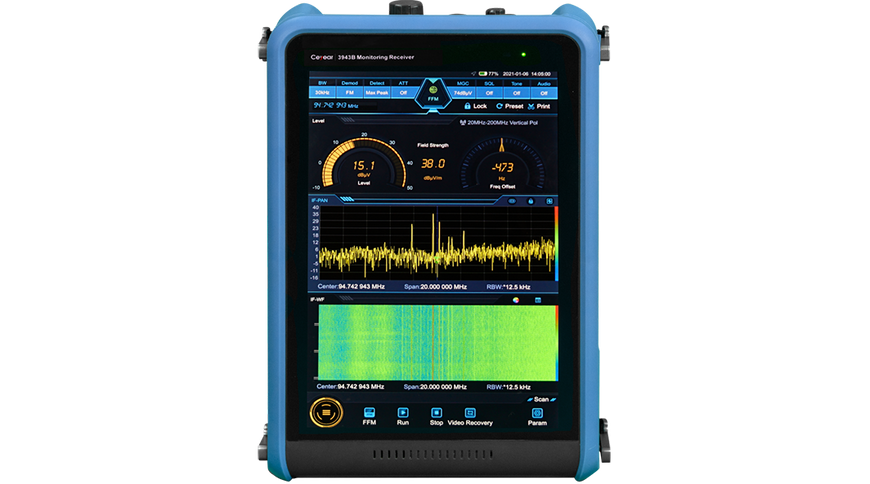
The overall size of the handheld monitoring receiver is 182.5mm×289mm×69mm, the weight of the whole machine is less than 3.5kg, the working time is 3-4h with battery, the display is 10.1-inch TFT, and the integrated touch screen. With multiple functions such as radio signal search, interception, measurement, analysis, demodulation, direction finding, positioning, etc., it can be used to perform emission monitoring, coverage measurement, illegal emission source/interference source rapid detection and positioning, and major activities that comply with ITU specifications Radio security and other tasks. The whole machine adopts a full touch screen design, and the software supports multi-touch interactive mode. The touch operation experience of the smart phone is completely transplanted to the monitoring receiver device. The users can conveniently complete the display trajectory zoom in, zoom out, window movement, parameter setting and other operations through touch gestures, providing a user-friendly UI interface to the greatest extent, so that the user can operate the monitoring receiver just like using a mobile phone or a pad computer.
Main Feature
- Excellent reception performance
- Multi-channel parallel operation
- Multi-mode scanning with ITU compliance
- Signal demodulation supporting multiple modulation patterns
- Computer video leak detection and restoration
- Manual radiation source direction finding by directional antenna
- Automatic radiation source direction finding through multi-element directional antenna
- Radiation source positioning function
- Radio signal recording function
- Audio and spectrum data playback
- Remote control
- High-precision time synchronization
- New operating concept
- Support multiple operation method
Excellent Reception Performance
- Wide monitoring frequency range (9kHz~8GHz) and direction finding frequency range (20MHz~6GHz) to meet current and future radio service signal reception
- Provide a maximum 20MHz analysis bandwidth, even a wide spectrum of short pulses or bursts can be detected and analyzed
- The full-band pre-selection design conforms to the radio frequency characteristics, that is, avoiding equipment overload, high-sensitivity receiving signal, supplemented by higher signal resolution, and superior reception performance
Multi-channel Parallel Operation
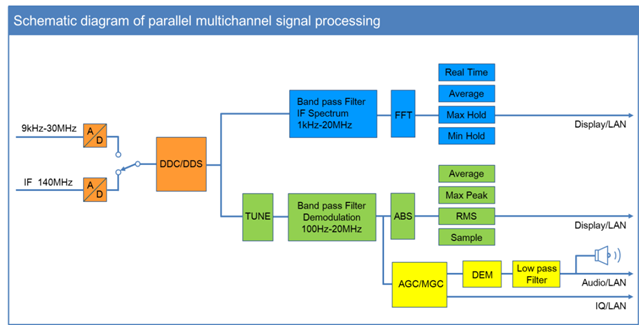
- Three parallel processing channels provide spectrum measurement, level field strength measurement and demodulation functions respectively, which is convenient for users to obtain multi-domain correlation analysis results of signals.
- The spectrum measurement channel's real-time spectrum bandwidth can be set from 1 kHz to 20MHz, with 35 steps from 0.625Hz to 2MHz resolution bandwidth. The spectrum can be selected to perform averaging, sampling, maximum hold or minimum hold before output through the screen or LAN interfaces
- The level field strength measurement channel has 34 IF filters, the IF bandwidth is from 100Hz to 20MHz, and can be selected independently of the spectrum bandwidth, which is convenient for users to process different signals with optimal signal ratio; level/field strength through screen or LAN interface Optional sampling, peak, power or average detection before output
- Demodulation channel receive level field strength measurement channel the complex baseband signal output of the IF filter can be directly used for FM/PM demodulation. The complex baseband signal adjusted by AGC/MGC can be directly output through the LAN interface or used for AM/LSB/USB/ISB/CW/PULSE demodulation and demodulation result data can be output through LAN interface; digital audio demodulation data can be output by LAN interface or converted into analog signal for speaker playback
Multi-mode Scanning with ITU Recommendations
Fixed Frequency Reception
It can realize spectrum measurement of fixed frequency points, display measurement information such as level, field strength and frequency offset, and combine signal demodulation function to measure and observe signals.
The receiving bandwidth is selectable from 1 kHz to 20MHz. The resolution bandwidth supports automatic matching and manual adjustment to meet different test scenario requirements.
Drag and demodulate the bandwidth histogram in the IF spectrum window to quickly modify the demodulation frequency, which is convenient and fast.
Real-time display of the IF waterfall map, and a variety of color display modes are available, support for adjusting the color display threshold, filtering the signal below the threshold for easy observation.
Support historical data playback, slide the waterfall map vertically or drag the historical frequency to display historical data in the spectrum window.

Panoramic Scan
Supports panoramic scanning in the 9kHz to 8GHz frequency range with resolution bandwidths from 100Hz to 2MHz for fast signal scanning.
Support differential mode for easy observation of signal changes and rapid detection of abnormal signals.
It can be linked with the fixed frequency receiving function to select the target frequency point on the panoramic trajectory, and the target frequency point information can be quickly correlated to the IF spectrum window. When the panoramic scanning stops, the fixed frequency receiving starts to work, which can be seamlessly switched for fast observation. Target frequency information.

Frequency Sweep
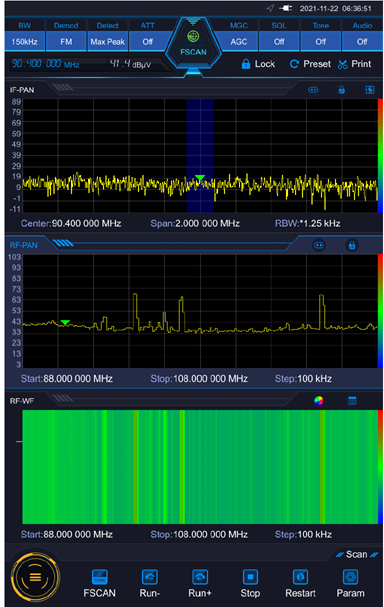
By setting the scanning frequency band range and the step frequency, the measured frequency band is divided into multiple frequency points, and then these frequency points are stepped and scanned with uniform parameters, including: bandwidth, squelch level, dwell time, demodulation Mode, attenuation mode, number of scans, etc.The fixed frequency receiving function works in parallel with the frequency scanning function. Each step to a frequency point associates the frequency point information with the fixed frequency receiving and stays at the frequency point. At this time, the specific frequency of the frequency point can be viewed in the intermediate frequency window.
It can realize frequency scanning in the frequency range of 9 kHz to 8GHz. The stepping frequency can be arbitrarily input in the range of 1Hz to 100MHz, supporting forward scanning and reverse scanning.
By setting the squelch level, you can control the dwell state of the frequency sweep to filter signals that are less than the squelch level.
The suppression table is used to record the frequency band to be ignored in the scanning frequency range. It includes two parameters of the starting frequency and the ending frequency. When the frequency scanning is stepped to the recording range of the suppression table, it is directly stepped to the next frequency point.The suppression table supports a maximum of 100 pieces of frequency information.
List Scan
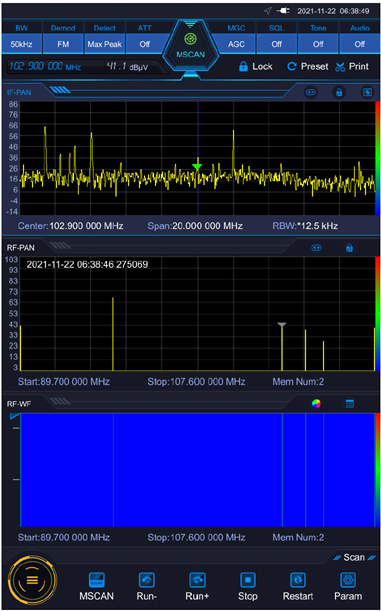
It can realize the scanning of the frequency of the storage table records one by one.
The fixed frequency receiving function and the list scanning function also work in parallel. Each time it switches to a frequency point, it will reside at the frequency point, and the band information is associated with the fixed frequency reception, and the spectrum can be measured and observed in the intermediate frequency window.The difference from the frequency sweep is that the parameters of the list scan at each frequency point can be arbitrarily set, including the center frequency, bandwidth, demodulation mode, attenuation mode, squelch value, squelch switch, activation state, etc.
The storage table can record up to 1000 scanning frequency points, supporting forward scanning and reverse scanning.
Signal Demodulation Supporting Multiple Modulation Patterns
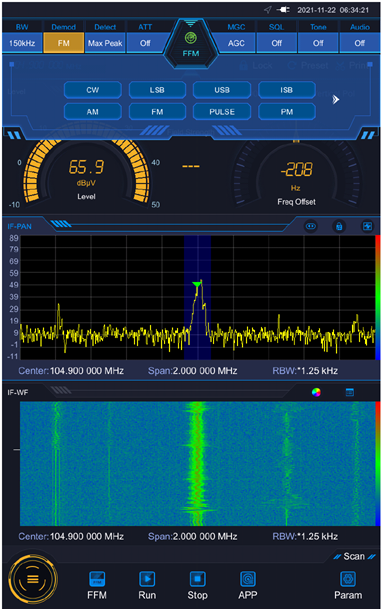
- Signal formats that support demodulation include FM/ PM/ AM/ LSB/ USB/ ISB/ CW/PULSE/IQ
- Supports up to 20MHz demodulation bandwidth, demodulation bandwidth can be set from 100Hz to 20MHz
- Automatic frequency control (AFC) for automatic tracking of received signals within the demodulation bandwidth
- Gain control allows users to get the best demodulation in complex environments; gain control switches between automatic gain control (AGC) and manual gain control (MGC)
- CW demodulation with BFO function, it is a secondary oscillator to recover CW carrier, BFO frequency range is 0 - ±8kHz
Computer Video Leak Detection and Restoration
- Ability to detect and restore images of computer video leaks
- Supported computer video signal format is HDMI
- Restore image stabilization
Manual Radiation Source Direction Finding by Directional Antenna
- 9kHz-20MHz, 20MHz-200MHz, 200MHz-500MHz, 500MHz-8GHz directional antenna full-band coverage
- Reflect 360-degree signal intensity distribution in compass mode, automatically indicating the maximum intensity direction
- Support digital map function for easy outdoor source search
- Directional, spectrum, digital map multi-window parallel display
- Intelligent control of antenna handle for user convenience

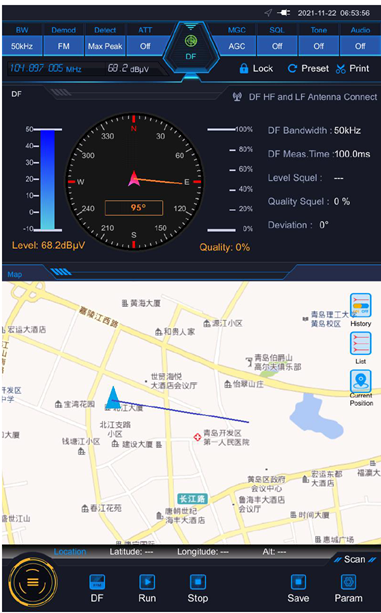
Automatic Radiation Source Direction-find through Multi-element Directional Antenna
- 20MHz-1.3GHz, 700MHz-6GHz multi-array DF antenna with single channel correlation interferometer algorithm for direction finding
- DF maximum bandwidth 20MHz, direction finding accuracy is better than 2RMS°
- Fastest direction of 30ms/time, with level threshold for direction finding of abnormal signals
- Support digital map function for easy outdoor source search
- Directional, spectrum, digital map multi-window parallel display

Radiation Source Positioning Function
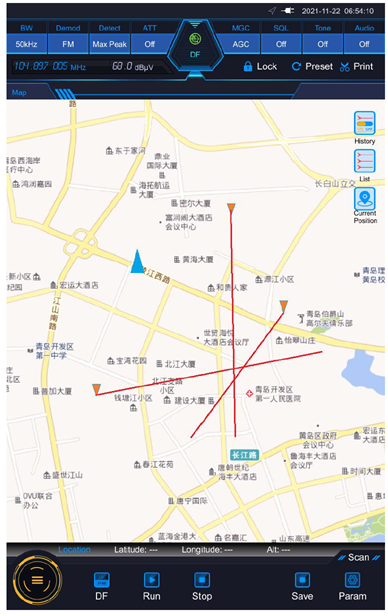
- Positioning the radiation source based on the direction finding result
- Direction finding results, positioning results can be visually displayed on a digital map
Radio Signal Recording Function
- Ability to record measurement data including IQ, audio and spectrum
- Data can be recorded to internal memory or external SD card
Audio and Spectrum Data Playback
- Ability to play back recorded audio and spectral data
- Audio data playback supports pause, fast forward, backward, etc.
- Spectrum data playback supports multiple playback rates for easy viewing
Remote Control
- Transmission of measurement data via LAN interface
- Measurement data including level data, spectrum data, audio data, IQ data
- IQ data transmission supporting up to 20MHz analysis bandwidth
High-precision Time Synchronization
- Support Beidou/GPS time synchronization function, data timestamp accuracy is better than 100ns, frequency accuracy is better than 0.01ppm
- Can be used to build TDOA positioning systems and multi-device collaborative work systems
New Operating Concept
- 10.1-inch widescreen LCD display with no buttons, full touch design
- Support a variety of common gesture operations, click, move, zoom, etc., convenient for users to operate
- Support multi-window display, display window can be customized, test information display is richer and more comprehensive
Support Multiple Operation Methods
- Supports a variety of usage methods such as hand-held, piggyback, and workbench, making it easy to adapt to various environments.
- Ergonomic grip strap for added comfort
- Separate bracket for more flexible operation and optimized support angle for clearer viewing data
- Carrying the best lightweight experience and excellent mobility, supporting tablet and mobile connected devices, supporting both wired and wireless interconnections
Typical Application
Radio Spectrum Monitoring
3943B can be applied to the radio regulatory department using the various scanning methods of the receiver to conveniently carry out the daily supervision business recommended by ITU.
Interference Source Lookup
The 3943B panoramic scanning function can quickly detect the interference caused by illegal radio stations interference sources sudden transmission etc. and quickly locate the interference source through horizontal scanning or DF direction finding function.
Radio Service Coverage Test
The actual coverage of the radio service is an important part before the service is launched. The 3943B can be used to easily implement the actual road test of the service signal and quickly complete the service coverage.
Site/mobile Station and other Site Selection Tests
Before the deployment of mobile stations reconnaissance positions etc. the location selection is very important. It is convenient to carry out field test using 3943B and obtain on site electromagnetic spectrum data to assist location decision.
Computer Security Assessment
Using the computer video leakage information detection and restoration function of 3943B the information leakage during the process of computer video signal transmission can be detected and the original display image can be restored to reflect the computer security status intuitively and truthfully.
Important Location Stealing Inspection
Whether it is commercial competition or espionage there is a clear upward trend. Anti stealing will become more and more important. You can use the 3943B to easily conduct confidential inspections on important places and eliminate wireless stealing equipment.
Major Event Radio Security
The 3943B is small in size and light in weight. It is especially suitable for performing radio security tasks in major ac tivities quickly discovering hidden dangers and ensuring the normal operation of radio frequency equipment.
Communication Signal Reconnaissance
As the core receiving device 3943B can be applied to the field of communication intelligence reconnaissance to realize real time monitoring of communication signals. Using the control interface of 3943B the IQ data in the analysis bandwidth can be obtained for the user's required intellig ence analysis.