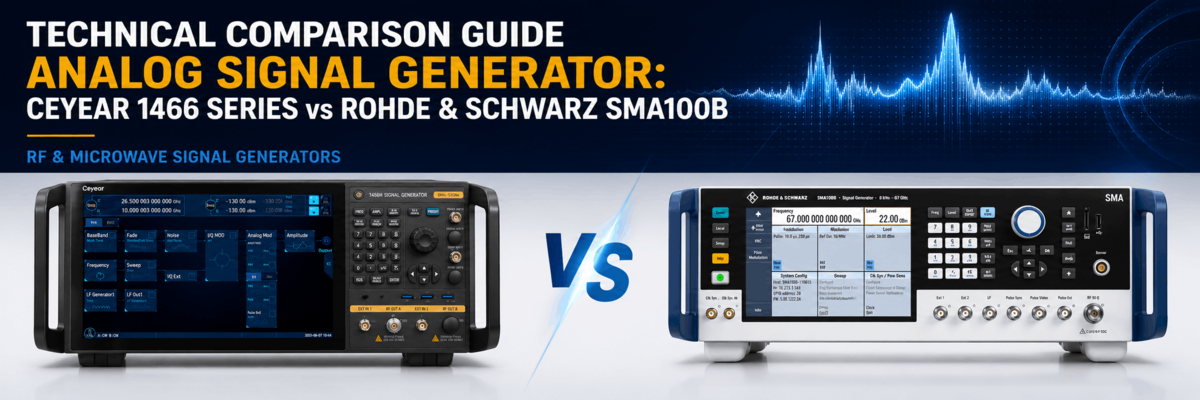
Technical Comparison Guide
Ceyear 1466 Series vs Rohde & Schwarz SMA100B
RF & Microwave Signal Generators
A side-by-side review of published manufacturer specifications
Uncompromising spectral purity. Full mmWave coverage to 110 GHz. Exceptional value — discover why the Ceyear 1466 series is the smart choice for your next test bench.
Source documents:
Ceyear “1466 Series Signal Generator” product datasheet (1466C/D/E/G/H/L/N/P)
Rohde & Schwarz “R&S® SMA100B RF and Microwave Signal Generator” Specifications, Version 10.00, February 2026
All values below are as published by each manufacturer at the time of writing. Figures marked (typ.) are typical, not warranted, values. “N/A” indicates the parameter is not published in the source datasheet for that instrument. Data without tolerance limits is not binding and is subject to change by the manufacturers.
 Download the Technical Comparison Guide
1. Product Overview
The Ceyear 1466 series and the Rohde & Schwarz SMA100B are both modular, high-performance CW/analog signal generator families intended for component-, subsystem- and system-level RF/microwave and millimeter-wave test. Each is offered across a family of frequency-range variants sharing a common platform, with options for high output power, low phase noise, extended dynamic range, pulse/analog modulation, and sweep functionality.
Table 1.1 – Family Overview
| Parameter | Ceyear 1466 Series | R&S® SMA100B |
| Manufacturer | Ceyear Technologies Co., Ltd | Rohde & Schwarz |
| Model family | 1466C / 1466D / 1466E / 1466G / 1466H / 1466L / 1466N / 1466P | SMAB-B103 / B106 / B112 / B120 / B131 / B140(N) / B150(N) / B167(N) |
| Frequency range covered by family | 6 kHz to 13 / 20 / 33 / 45 / 53 / 67 / 90 / 110 GHz | 8 kHz to 3 / 6 / 12.75 / 20 / 31.8 / 40 / 50 / 67 GHz (overrange to 72 GHz) |
| Highest-frequency coaxial model | 1466P: 6 kHz to 110 GHz | SMAB-B167(N): 8 kHz to 67 GHz (72 GHz overrange) |
| External frequency extension | Ceyear 8240X series signal source extender (to 750 GHz) | N/A (not published in this datasheet) |
| Dual RF channel | Yes – single main unit, two independently settable channels (option 1466-H11-B13/B20) | N/A (single RF output per instrument in this datasheet) |
| Display / interface | 11.6″ touchscreen, browser/cross-platform client access, SCPI recording with auto-generated program-control samples | 5″ touch display (2 HU) or 7″ touch display (3 HU), VNC remote operation |
| Housing | Benchtop, rack-mountable (option 1466-H94) | 2 HU or 3 HU rack housing (SMAB-B92 / SMAB-B93) |
Technical Assessment
The comparison immediately reveals two different design philosophies. Rather than competing with identical hardware configurations, the Ceyear 1466 Series and the Rohde & Schwarz SMA100B are modular signal generator families optimized for different priorities.
The Ceyear 1466 Series emphasizes frequency scalability and system flexibility. The family extends from 6 kHz to 110 GHz using coaxial outputs and can be further expanded to 750 GHz with the Ceyear 8240X signal source extender. In addition, Ceyear offers an optional dual-RF-channel configuration within a single mainframe, allowing two independently controlled RF outputs from one instrument.
The R&S SMA100B focuses on compact mechanical design, smaller rack height, and a modular frequency architecture based on interchangeable frequency options. Depending on the selected configuration, the instrument supports frequencies from 3 GHz up to 67 GHz, with specified overrange operation to 72 GHz on the highest-frequency model.
From a system integration perspective, both manufacturers provide modern touchscreen interfaces and remote control capabilities, but they approach automation differently. Ceyear integrates browser-based multi-client access together with automatic SCPI command recording and code generation, whereas Rohde & Schwarz emphasizes VNC remote operation within its established automation ecosystem.
Practical Impact
For laboratories performing RF, microwave and mmWave development across multiple frequency bands, the available frequency range often determines the useful lifetime of the instrument. Engineers expecting future migration beyond 67 GHz may benefit from the wider native frequency coverage of the Ceyear 1466 Series, while users already standardized on Rohde & Schwarz automated test platforms may appreciate the SMA100B's compact architecture and established software environment.
Key Takeaway
Both product families target high-performance RF and microwave applications, but the Ceyear 1466 Series prioritizes wider frequency coverage and system flexibility, while the R&S SMA100B emphasizes compact implementation and integration into existing automated test environments.
2. Frequency Characteristics
Introduction
Frequency coverage is one of the fundamental characteristics of any RF signal generator, determining the range of applications that can be addressed without additional frequency conversion hardware. Beyond the available frequency span, parameters such as frequency resolution, switching speed and reference oscillator stability directly influence measurement accuracy, automated test throughput and long-term system performance.
The Ceyear 1466 Series and the Rohde & Schwarz SMA100B are both designed as high-performance microwave signal generators, yet they adopt different design philosophies. The following comparison summariz < 2.0 ms (B103/B106/B112/B120); < 2.5 ms (B131/B140(N)/B150(N)/B167(N)); < 5.5 ms (with B711(N) option) es the official manufacturer specifications for frequency characteristics.
Table 2.1 – Frequency Range & Resolution
| Parameter | Ceyear 1466 Series | R&S® SMA100B |
| Frequency range (lowest model) | 1466C: 6 kHz to 13 GHz | SMAB-B103: 8 kHz to 3 GHz |
| Frequency range (highest model) | 1466P: 6 kHz to 110 GHz | SMAB-B167(N): 8 kHz to 67 GHz (72 GHz overrange) |
| Setting resolution | 0.001 Hz | 0.001 Hz |
| Switching / setting speed | < 15 ms | < 2.0 ms (B103/B106/B112/B120); < 2.5 ms (B131/B140(N)/B150(N)/B167(N)); < 5.5 ms (with B711(N) option) |
| Aging rate (typ.) | ±5×10⁻¹⁰/day after 30 days | Standard: ≤1×10⁻⁹/day, ≤1×10⁻⁷/year. With B1H/B709/B710(N)/B711(N): ≤5×10⁻¹⁰/day, ≤3×10⁻⁸/year |
| Reference output frequency / power | 10 MHz, >+4 dBm into 50 Ω | 10 MHz standard (100 MHz, 1 GHz with K703 option), 7–14 dBm |
| Reference input | 1–100 MHz (1 Hz step), –5 dBm to +10 dBm, 50 Ω | 10 MHz standard; 100 MHz with K703; 1 MHz–100 MHz variable with K704; 1 GHz ultra-low-noise input with K703 |
Technical Assessment
The comparison highlights one of the most significant differences between the two product families: maximum operating frequency. The Ceyear 1466 Series provides native frequency coverage extending to 110 GHz, whereas the Rohde & Schwarz SMA100B is available with frequency options up to 67 GHz.
Both instruments provide excellent frequency resolution suitable for precision RF and microwave measurements. Modern fractional-N synthesis and high-stability reference oscillators allow accurate frequency generation across the entire operating range.
For laboratories working across multiple microwave bands, the wider native frequency coverage of the Ceyear 1466 Series reduces the need for external frequency extension hardware in many applications, particularly in E-band and W-band development.
Practical Impact
Applications such as millimeter-wave communications, automotive radar development and high-frequency component characterization increasingly require signal generation above 67 GHz. In these scenarios, the wider native frequency range of the Ceyear 1466 Series provides greater measurement flexibility, while the SMA100B fully addresses conventional RF and microwave applications within its specified operating range.
Key Takeaway
Both generators provide high-precision frequency synthesis, while the Ceyear 1466 Series offers substantially broader native frequency coverage for millimeter-wave applications.
3. Output Power Characteristics
Introduction
RF output power is a fundamental performance characteristic of any RF and microwave signal generator. It determines the ability to compensate for cable losses, drive passive components with high insertion loss, characterize mixers and frequency converters, and perform receiver sensitivity testing without requiring external RF amplification.
In addition to maximum available output power, practical laboratory performance depends on minimum output level, dynamic range, level resolution, output accuracy and impedance matching. Together, these parameters define the generator's flexibility across a wide range of RF and microwave measurement applications.
The following comparison summarizes the published output power specifications of the Ceyear 1466 Series and the Rohde & Schwarz SMA100B using official manufacturer data only.
Table 3.1 – Representative Maximum Output Power (typical, standard config.)
| Parameter | Ceyear 1466 Series | R&S® SMA100B |
| ~1 GHz / low-GHz region | 1466D: ≥+15 dBm (standard, 50 MHz–20 GHz); up to +27 dBm typ. @5 GHz w/ high-power option | SMAB-B106 standard: up to +19 dBm (1 MHz–6 GHz); up to +30 dBm with K31+B32 options |
| ~10 GHz region | 1466E/G: ≥+12 dBm standard (6–18 GHz); up to +20 dBm with high-power options | SMAB-B131/B140(N) standard: +14 dBm (1 MHz–18 GHz); up to +24 dBm typ. with B35/K36 options |
| ~20 GHz region | 1466D: +24 dBm typ. (measured, high-power option H05-20) | SMAB-B120 standard: +17 dBm (13–20 GHz); up to +28 dBm typ. with K33/B34 options |
| ~40–45 GHz region | 1466G: +22 dBm typ. (measured, high-power option H05-45) | SMAB-B140(N): +13 dBm standard (18–40 GHz); up to +30 dBm typ. with B35/K36/B36S options |
| ~60–67 GHz region | 1466N/P: +22 dBm typ. @60 GHz | SMAB-B167(N): +5 dBm standard (40–67 GHz); up to +20 dBm typ. with B37/K38/B39/K40 options |
| ~110 GHz (1466P only) | +3 dBm typ. | N/A – above SMA100B's 67 GHz (72 GHz overrange) coverage |
Technical Assessment
The comparison demonstrates that both manufacturers provide multiple hardware configurations optimized for different frequency ranges and output power requirements. Rather than specifying a single maximum output level for the entire product family, both platforms offer dedicated high-power options that significantly increase available RF power within specific frequency bands.
Across the microwave frequency range, both generators maintain excellent output capability suitable for component characterization, receiver testing and production environments. As expected, available RF power gradually decreases as operating frequency increases, reflecting the practical limitations of microwave power amplifier technology.
One notable advantage of the Ceyear 1466 Series is its ability to maintain useful output power beyond 67 GHz, extending to 110 GHz with the 1466P model. This enables direct signal generation within the W-band without requiring an external frequency multiplication stage.
Practical Impact
Higher RF output power provides greater flexibility when compensating for losses introduced by cables, switches, attenuators and passive fixtures. In many practical measurement systems this eliminates the need for an external broadband amplifier, reducing measurement uncertainty while simplifying the overall test configuration.
For laboratories working above 67 GHz, the native output capability of the Ceyear 1466P further reduces system complexity by avoiding external frequency extension hardware for many millimeter-wave applications.
Key Takeaway
Both product families provide high RF output power across their respective operating ranges, while the Ceyear 1466 Series extends useful output capability into the 90 GHz and 110 GHz frequency bands.
Table 3.2 – Minimum Output Power / Dynamic Range
| Parameter | Ceyear 1466 Series | R&S® SMA100B |
| Minimum output power (standard) | –10 dBm (settable to –20 dBm) | Level range starts at –90 to –127 dBm depending on band (standard); setting range down to –145 dBm |
| Minimum settable power (with attenuator option) | Down to –150 dBm (option H01-130/90/120/50 + H01-B130) | Down to –145 dBm (all frequency options, setting range) |
| Output power dynamic range | Up to 170 dB | Up to ~172 dB (setting range span, e.g. –145 dBm to +25–40 dBm depending on option) |
| Power resolution | 0.01 dB | 0.01 dB |
| Power accuracy (typ., <20–25 GHz) | < 0.5 dB (typ., below 20 GHz) | < 0.5 dB (8 MHz < f ≤ 3 GHz, level –90 to +25 dBm) |
| Output impedance | 50 Ω (nom.) | 50 Ω (nom.) |
| VSWR (typ.) | < 1.6 (100 kHz–20 GHz) to < 3.0 (85–110 GHz) | < 1.6–1.9 (200 kHz–20 GHz) to < 2.0 (3–50 GHz, meas.) |
Technical Assessment
Dynamic range is one of the defining characteristics of a modern RF signal generator. A wide programmable output range enables both high-power stimulus generation and extremely low-level signal simulation using a single instrument configuration.
Both generators provide exceptionally wide output level ranges together with fine 0.01 dB level resolution, allowing precise amplitude control over a broad range of measurement conditions. Such performance is particularly valuable for receiver sensitivity testing, gain compression measurements and automated calibration procedures where repeatable power settings are essential.
The availability of optional step attenuator configurations further extends the usable dynamic range, enabling accurate low-level signal generation while preserving output level accuracy and repeatability.
Practical Impact
Receiver sensitivity measurements often require signal levels below –120 dBm, while amplifier and mixer characterization may require output levels exceeding +20 dBm. A generator capable of covering this entire range without external attenuation or amplification simplifies the measurement setup, reduces calibration effort and improves overall measurement confidence.
Both the Ceyear 1466 Series and the Rohde & Schwarz SMA100B provide the dynamic range expected from premium laboratory signal generators, making them suitable for demanding RF, microwave and automated production applications.
Key Takeaway
Both generators offer excellent output level control, wide dynamic range and high amplitude resolution, providing the flexibility required for precision RF measurements across a broad range of signal levels.
Section Conclusion
Output power characteristics directly influence the versatility of an RF signal generator across laboratory, production and research environments. Both the Ceyear 1466 Series and the Rohde & Schwarz SMA100B provide high RF output power, wide programmable dynamic range and excellent amplitude control suitable for demanding microwave measurements.
The Ceyear 1466 Series distinguishes itself by maintaining useful RF output capability beyond 67 GHz, while the SMA100B offers a broad selection of optional high-power configurations across its supported frequency models. Both platforms therefore provide the output performance expected from premium RF and microwave signal generators, with the final configuration depending primarily on the required frequency range and application requirements.
4. Spectral Purity
Introduction
Spectral purity is one of the most critical performance characteristics of an RF and microwave signal generator. It directly affects the quality of receiver sensitivity measurements, phase noise characterization, radar testing, oscillator evaluation and the verification of high-dynamic-range RF components.
Unlike frequency coverage or output power, spectral purity cannot be compensated for elsewhere in the measurement system. Any phase noise, harmonic distortion or spurious emissions generated by the signal source become part of the applied test signal and may directly limit measurement accuracy. For this reason, engineers developing communication systems, radar equipment and precision oscillators often consider spectral purity to be the most important criterion when selecting a high-performance signal generator.
The following comparison summarizes the published spectral purity specifications of the Ceyear 1466 Series and the Rohde & Schwarz SMA100B using only official manufacturer documentation.
Table 4.1 – SSB Phase Noise (typical, 10 kHz offset, ~10 GHz carrier)
| Parameter | Ceyear 1466 Series | R&S® SMA100B |
| Standard / base performance | –120 dBc/Hz (option 1466-H04-1 baseline reference) | –118 dBc/Hz typ. (standard, f=10 GHz, 10 kHz offset) |
| Best available option | –132 dBc/Hz typ. (option H04-2, ultra-low phase noise, 10 GHz carrier, 10 kHz offset) | –125 dBc/Hz (spec.) / –130 dBc/Hz (typ.) with B711 ultra-low-phase-noise option, f=10 GHz, 10 kHz offset |
| Close-in phase noise, 1 kHz offset @10 GHz (best option) | –114 dBc/Hz (H04-2 option) | –140 dBc/Hz (spec.) / –146 dBc/Hz (typ.) with B711 option |
| Phase noise @1 GHz, 10 kHz offset | –145 dBc/Hz typ. (option H04-2 baseline claim) | –140 dBc/Hz (standard); down to –147 dBc/Hz (typ.) with B711 option |
The two manufacturers do not publish phase-noise data at fully identical offsets/options, so figures above are the closest matching published points; consult the full tables in each source datasheet for the complete offset/carrier grid.
Technical Assessment
Single-sideband (SSB) phase noise is one of the primary indicators of signal quality. Low phase noise minimizes reciprocal mixing effects, reduces measurement uncertainty when characterizing oscillators and synthesizers, and improves the accuracy of receiver blocking, adjacent-channel selectivity and radar performance measurements.
The comparison shows that both manufacturers offer optional ultra-low-phase-noise configurations that significantly improve performance compared with their standard instrument configurations. This allows customers to optimize the generator for either general laboratory applications or demanding phase-noise-sensitive measurements.
One noticeable distinction is that the SMA100B achieves exceptionally low close-in phase noise with its highest-performance option, particularly at small frequency offsets from the carrier. Conversely, the Ceyear 1466 Series provides excellent phase noise performance while maintaining its broader native frequency coverage up to 110 GHz, allowing low-noise signal generation across an extended millimeter-wave frequency range.
Practical Impact
For general RF measurements, standard phase noise performance is typically sufficient. However, applications involving local oscillator development, high-performance radar, satellite communications or frequency metrology benefit significantly from ultra-low-phase-noise configurations. In these environments, even a few decibels of phase noise improvement can noticeably increase measurement accuracy.
Key Takeaway
Both generators offer excellent phase noise performance, while the highest-performance SMA100B configuration achieves lower close-in phase noise, and the Ceyear 1466 Series combines low phase noise with substantially broader native frequency coverage.
Table 4.2 – Wideband Noise Floor (typ., near 20–30 MHz offset)
| Parameter | Ceyear 1466 Series | R&S® SMA100B |
| ~20 GHz carrier | < –161 dBc/Hz @30 MHz offset, 20 GHz carrier | < –145 dBc/Hz (typ.) @ carrier offset 40 MHz, 20–40 GHz range (standard); improved with B711(N) option |
| ~10 GHz carrier | < –150 dBc/Hz (implied from spectral purity curve, 10 GHz) | < –150 dBc/Hz, carrier offset 40 MHz, 6–12 GHz (standard) |
Technical Assessment
Wideband noise floor becomes increasingly important when evaluating wideband communication receivers, broadband amplifiers and high-dynamic-range microwave components. Unlike close-in phase noise, wideband noise primarily influences measurements performed at larger carrier offsets where broadband receiver performance is evaluated.
Both generators demonstrate excellent broadband spectral purity suitable for modern RF communication and microwave applications. The published specifications indicate that each platform maintains a very low broadband noise floor across its supported operating frequency range, allowing accurate receiver sensitivity and adjacent-channel measurements.
Because the manufacturers publish broadband noise data using different carrier frequencies and offset conditions, direct numerical comparison should be interpreted carefully. The specifications nevertheless demonstrate that both platforms belong to the premium class of laboratory RF signal generators.
Practical Impact
Wideband noise floor becomes particularly important when evaluating broadband receivers, software-defined radios, satellite communication systems and high-performance microwave front ends. Lower broadband noise reduces measurement uncertainty and improves the repeatability of receiver sensitivity testing.
Key Takeaway
Both signal generators provide broadband noise performance suitable for demanding laboratory measurements, supporting accurate characterization of modern wideband RF systems.
Table 4.3 – Harmonics / Sub-harmonics / Non-harmonic Spurious
| Parameter | Ceyear 1466 Series | R&S® SMA100B |
| Harmonics (typ., mid-band) | < –55 dBc (3 GHz < f ≤ 67 GHz, at +10 dBm or max. specified power) | < –55 dBc (100 kHz < f ≤ 10 MHz: <–30 dBc; f > 10 MHz: <–55–60 dBc depending on option) |
| Sub-harmonics | < –80 dBc (6 kHz–20 GHz); < –60 dBc (20–40 GHz); < –50 dBc (40–110 GHz) | < –85 dBc (f ≤ 5 GHz, standard) / < –95 dBc with B711(N); < –60 dBc (5–50 GHz) |
| Non-harmonic spurious | < –58 to –80 dBc depending on option (H04-1/H04-2) and frequency band | < –56 to –100 dBc depending on frequency and phase-noise option (offset >10 kHz) |
Technical Assessment
Harmonic and spurious suppression determines how closely the generated RF signal approaches an ideal single-frequency carrier. Low harmonic distortion minimizes the need for external filtering while reducing the possibility of unwanted responses during receiver testing and frequency conversion measurements.
Both manufacturers specify excellent harmonic suppression across most of the operating frequency range. As expected, harmonic and sub-harmonic performance varies with operating frequency and installed hardware options, reflecting the practical limitations of broadband microwave signal generation.
The published specifications also demonstrate excellent suppression of non-harmonic spurious signals, making both generators suitable for precision RF measurements where unwanted spectral components could otherwise influence measurement results. Since harmonic and spurious performance depends strongly on the selected frequency option and phase-noise configuration, users should always verify the specifications corresponding to their intended hardware configuration.
Practical Impact
Poor harmonic or spurious performance can introduce measurement errors that are often difficult to identify, particularly when testing mixers, frequency converters and highly selective receivers. High spectral purity minimizes these risks and often eliminates the need for additional external filtering, simplifying both laboratory and automated production test systems.
Key Takeaway
Both product families provide excellent harmonic and spurious suppression, enabling high-confidence RF measurements across communication, radar and microwave component test applications.
Section Conclusion
Spectral purity remains one of the defining performance characteristics of any premium RF signal generator. The published specifications demonstrate that both the Ceyear 1466 Series and the Rohde & Schwarz SMA100B provide outstanding signal quality suitable for demanding laboratory and production environments.
The SMA100B offers exceptionally low close-in phase noise with its highest-performance options, while the Ceyear 1466 Series combines competitive spectral purity with native frequency coverage extending to 110 GHz. Both platforms therefore represent high-performance solutions for precision RF, microwave and millimeter-wave signal generation, with the optimal choice depending on the specific balance between phase noise requirements, operating frequency and application priorities.
5. Analog & Pulse Modulation
Introduction
Modern RF signal generators are expected to provide much more than a stable continuous-wave (CW) signal. Built-in analog and pulse modulation capabilities enable engineers to simulate realistic communication, radar and electronic warfare (EW) signals without requiring additional external modulation hardware.
The availability of AM, FM, phase modulation, pulse modulation and advanced pulse generation functions significantly expands the range of applications that can be performed using a single instrument. For many laboratories, integrated modulation functionality reduces system complexity, shortens test setup time and improves measurement repeatability.
The following comparison summarizes the modulation capabilities published by Ceyear and Rohde & Schwarz in their official specifications.
Table 5.1 – Modulation Capabilities
| Parameter | Ceyear 1466 Series | R&S® SMA100B |
| AM | Yes (option 1466-S11), max. depth >90%, accuracy ±(5% of setting+1%) | Yes (option SMAB-K720), max. depth >90%, accuracy < (3% of reading + 1%) |
| FM | Yes (option 1466-S11), max. deviation N×20 MHz, DC–10 MHz mod. rate | Yes (option SMAB-K720), max. deviation N×10 MHz (high-BW mode) or N×100 kHz (low-noise mode) |
| ΦM (phase modulation) | Yes (option 1466-S11), max. deviation N×20 rad (normal mode) | Yes (option SMAB-K720), max. deviation N×20 rad (high-deviation mode) |
| Pulse modulation | Yes (option 1466-S12/S13), min. pulse width 20 ns (S13) or 100 ns (S12) | Yes (option SMAB-K22), min. pulse width 20 ns (30 ns for B140N/B150N/B167N) |
| Complex pulse functions | Double pulse, pulse train, PRF jittering, PRF staggering, PRF sliding | Double pulse, pulse train (option SMAB-K27), chirped pulses (option SMAB-K725) |
| On/off ratio (pulse mod.) | > 80 dB (≤67 GHz, option S13); > 60 dB (>67 GHz) | > 80 dB |
| Rise/fall time (pulse mod.) | < 10 ns (option S13, 50–67 GHz); < 20 ns (option S12) | < 10 ns typ. (700 MHz–50 GHz); 5 ns typ. |
| Avionics modulation (VOR/ILS/MKR/ADF) | Not offered in this datasheet | Yes (option SMAB-K25) |
| LF output / function generator | Yes (option 1466-S14): sine, square, triangle, sawtooth, noise, double sine, sweep sine; DC–10 MHz | Yes (multifunction generator, option SMAB-K24): sine, square, pulse, triangle, trapezoid, noise; up to 10 MHz |
Technical Assessment
Both product families provide comprehensive analog modulation capabilities, including amplitude modulation (AM), frequency modulation (FM) and phase modulation (PM), supporting the majority of conventional RF receiver and subsystem testing applications. These modulation modes remain fundamental for evaluating communication receivers, RF amplifiers and frequency conversion stages.
Pulse modulation is equally important for radar, aerospace and defense applications. Both generators support fast pulse generation with minimum pulse widths down to 20 ns, making them suitable for modern radar pulse simulation and receiver testing.
A notable difference between the two platforms lies in their advanced pulse functionality. The Ceyear 1466 Series incorporates features such as pulse train generation together with PRF jittering, PRF staggering and PRF sliding, allowing more realistic simulation of complex radar pulse sequences. These capabilities are particularly valuable for electronic warfare (EW), radar development and advanced pulse-based system verification.
The SMA100B, meanwhile, complements its pulse modulation capabilities with optional avionics signal generation and legacy modulation formats intended for navigation and aerospace applications. This provides additional flexibility for users working with VOR, ILS, marker beacon and ADF receiver testing.
Both manufacturers also integrate low-frequency signal generation into the instrument, allowing internal modulation sources to be used without requiring external function generators for many standard laboratory applications.
Practical Impact
Integrated modulation capabilities reduce the number of instruments required on the test bench and simplify automated measurement systems. Instead of combining multiple external generators, modulators and synchronization hardware, engineers can create complex RF test signals directly within a single instrument.
For communication system development, standard AM, FM and PM functionality is generally sufficient. Laboratories involved in radar, electronic warfare or pulse-compression system development benefit from more sophisticated pulse generation features that can reproduce realistic operational scenarios without additional waveform-generation equipment.
Key Takeaway
Both signal generators provide comprehensive analog and pulse modulation capabilities suitable for modern RF laboratories. The Ceyear 1466 Series places greater emphasis on advanced radar-oriented pulse generation, while the SMA100B extends its functionality with optional avionics modulation and specialized application-specific features.
Section Conclusion
Modulation capability is a key factor in determining how broadly a signal generator can be applied across communication, radar and aerospace testing. The published specifications show that both the Ceyear 1466 Series and the Rohde & Schwarz SMA100B support a comprehensive set of analog and pulse modulation functions suitable for demanding RF applications.
The Ceyear 1466 Series distinguishes itself through its extensive built-in radar pulse generation features, while the SMA100B provides additional application-specific options for avionics testing. Both platforms therefore offer the flexibility required for advanced laboratory, verification and automated production environments, with the preferred solution depending on the intended application domain.
6. Sweep and List Mode
Introduction
Sweep and List Mode capabilities are essential for automated RF testing, allowing a signal generator to rapidly change frequency or output power according to predefined sequences. These functions are widely used for filter characterization, amplifier testing, receiver verification, EMC investigations and high-volume production testing, where measurement speed and repeatability are critical.
Modern RF signal generators typically support both discrete step-based sweeps and continuous analog frequency sweeps. Combined with programmable list mode, these capabilities enable automated execution of complex test procedures while minimizing control overhead from external software.
The following comparison summarizes the published sweep and list mode capabilities of the Ceyear 1466 Series and the Rohde & Schwarz SMA100B.
Table 6.1 – Sweep Characteristics
| Parameter | Ceyear 1466 Series | R&S® SMA100B |
| Sweep modes | Step sweep, List sweep, Ramp (analog) sweep (option S15), Power sweep (option S16) | Step (digital) sweep, List mode, Ramp sweep (option SMAB-B28) |
| Maximum ramp/analog sweep rate | 400 MHz/ms (f > 4 GHz, option S15) | Up to 4 GHz/ms (48–67 GHz band, option SMAB-B28); 500 MHz/ms (8–375 MHz band) |
| Frequency accuracy during sweep | ±0.05% of span (100 ms sweep time) | (0.005% of span) / (sweep time in s) |
| Interruption-free level sweep range | N/A (not separately published) | > 20 dB standard; > 60 dB (70 dB typ.) with high-dynamic uninterrupted option SMAB-K724 |
Technical Assessment
Both product families provide comprehensive sweep functionality, supporting step frequency sweeps, list mode operation and continuous ramp sweeps through optional hardware configurations. These capabilities enable automated characterization of RF components over wide frequency ranges while maintaining stable output level and frequency accuracy.
Step sweep remains the preferred method for precise laboratory measurements because it allows instruments under test to settle before each measurement point is acquired. In contrast, continuous ramp sweep is optimized for applications requiring rapid frequency transitions, such as production testing, broadband component evaluation and EMC investigations.
The published specifications indicate that the SMA100B achieves significantly higher maximum analog sweep rates in certain frequency bands, making it particularly well suited for high-speed automated test environments. The Ceyear 1466 Series, however, provides a balanced combination of sweep functionality together with power sweep capability and flexible list generation, allowing a broad range of automated RF measurements without requiring additional external equipment.
Another advantage of both platforms is the availability of programmable list mode, which enables users to define custom sequences of frequency and power settings for automated testing. This approach significantly reduces communication overhead between the control software and the instrument while improving overall test throughput.
Practical Impact
Sweep functionality directly affects measurement efficiency. During filter alignment, amplifier characterization or antenna verification, automated sweeps can reduce measurement time from several minutes to only a few seconds while ensuring excellent repeatability.
List mode is particularly valuable in automated production systems where hundreds or thousands of predefined test points must be executed repeatedly. Since the complete sequence is stored inside the generator, communication delays are minimized and deterministic timing can be maintained throughout the entire test cycle.
Power sweep capability further extends measurement flexibility by allowing engineers to evaluate gain compression, receiver sensitivity, automatic gain control (AGC) performance and linearity without manually adjusting signal levels.
Key Takeaway
Both signal generators provide comprehensive sweep and list mode functionality suitable for laboratory and automated production testing. The SMA100B emphasizes extremely high sweep speed, while the Ceyear 1466 Series combines flexible sweep modes, programmable list operation and integrated power sweep capability for a wide range of RF measurement applications.
Section Conclusion
Sweep and list mode functionality plays a central role in improving the efficiency of modern RF and microwave measurements. The published specifications demonstrate that both the Ceyear 1466 Series and the Rohde & Schwarz SMA100B provide the automation features expected from premium laboratory signal generators.
The SMA100B offers exceptionally fast analog sweep performance for high-throughput automated testing, while the Ceyear 1466 Series delivers a versatile combination of frequency sweep, list mode and power sweep capabilities that support communication, radar, electronic warfare and general RF laboratory applications. Both platforms therefore provide the flexibility required for efficient automated measurements, with the preferred solution depending on application priorities and workflow requirements.
7. General & Physical Characteristics
Introduction
While RF performance specifications often receive the greatest attention, the physical characteristics of a signal generator can have a significant impact on day-to-day laboratory operation and long-term deployment. Mechanical dimensions, weight, connector selection, environmental specifications and power requirements all influence installation, transportation, maintenance and integration into automated test systems.
For research laboratories, production facilities and field calibration environments, these practical considerations contribute directly to system reliability, ease of installation and overall cost of ownership. Connector type is particularly important at microwave and millimeter-wave frequencies, where mechanical compatibility and connector precision directly affect measurement accuracy.
The following comparison summarizes the published mechanical and environmental specifications of the Ceyear 1466 Series and the Rohde & Schwarz SMA100B.
Table 7.1 – General Data
| Parameter | Ceyear 1466 Series | R&S® SMA100B |
| RF output connector | 3.5 mm (1466C/D), 2.4 mm (E/G), 1.85 mm (H/L), 1.0 mm (N/P) – all male, 50 Ω | N female (B103/B106); 2.92 mm (B112–B140(N)); 1.85 mm (B150/B167(N)) |
| Dimensions (W × H × D, incl. handles) | 475 × 193 × 620 mm | 460 × 107 × 503 mm (2 HU) or 460 × 151 × 503 mm (3 HU) |
| Weight | < 35 kg (model/option dependent) | 14.4 kg (2 HU, fully equipped) / 18.0 kg (3 HU, fully equipped) |
| Power requirements | 100–120 VAC or 200–240 VAC, 50–60 Hz (adaptive) | 100–240 VAC ±10%, 50–60 Hz or 400 Hz |
| Power consumption | < 600 W | ~300 W (2 HU) / ~380 W (3 HU), measured |
| Operating temperature range | 0 °C to +50 °C | 0 °C to +55 °C (0 °C to +45 °C with B36S option) |
| Storage temperature range | –40 °C to +70 °C | –40 °C to +71 °C |
Technical Assessment
Both manufacturers employ precision RF connectors that are appropriate for their respective operating frequency ranges, transitioning from larger coaxial interfaces at lower frequencies to high-performance millimeter-wave connectors on higher-frequency models. This ensures good mechanical stability and measurement repeatability while supporting the frequency coverage of each instrument family.
The two product families follow different design philosophies regarding mechanical construction. The Ceyear 1466 Series is designed as a full-featured laboratory instrument with a larger chassis that accommodates its wide frequency coverage, optional dual-channel architecture and extensive internal hardware options. The SMA100B adopts a more compact rack-oriented architecture that minimizes occupied rack space and overall instrument weight, making it particularly attractive for dense automated test systems.
Environmental specifications published by both manufacturers demonstrate suitability for demanding laboratory and industrial operating conditions. Wide operating temperature ranges, standard AC power compatibility and robust mechanical construction enable reliable operation across research laboratories, manufacturing facilities and calibration environments.
Practical Impact
Physical size becomes increasingly important when multiple RF instruments are installed in production racks or automated test systems. A compact chassis allows higher equipment density and can reduce infrastructure requirements, particularly in large manufacturing environments.
Conversely, laboratories focused on flexibility and long-term capability may prioritize instrument architecture, upgrade options and frequency scalability over minimum rack space. Connector selection also becomes increasingly important above 50 GHz, where proper connector handling and mechanical repeatability are essential for maintaining measurement accuracy and minimizing calibration uncertainty.
Power consumption and environmental specifications influence operating costs and installation planning but generally represent a secondary consideration compared with RF performance for most laboratory applications.
Key Takeaway
Both product families are designed for professional laboratory and production environments, offering robust mechanical construction and high-quality RF interfaces. The SMA100B emphasizes compact size and reduced weight, while the Ceyear 1466 Series prioritizes system capability, hardware expandability and broad millimeter-wave frequency coverage.
Section Conclusion
The published mechanical and environmental specifications demonstrate that both the Ceyear 1466 Series and the Rohde & Schwarz SMA100B are engineered for demanding RF laboratory and automated test applications.
The SMA100B provides clear advantages where rack density, reduced weight and compact system integration are primary considerations. In contrast, the Ceyear 1466 Series offers a larger laboratory platform designed to accommodate its extensive hardware capabilities, wider native frequency coverage and optional dual-channel configuration. The appropriate choice therefore depends not only on RF performance requirements but also on the intended laboratory environment, installation constraints and long-term system expansion plans.
8. Remote Control & Connectivity
Introduction
Modern RF signal generators are increasingly integrated into automated measurement systems rather than operated solely from the front panel. As a result, remote control capabilities, communication interfaces and software integration have become key selection criteria for research laboratories, production environments and automated test equipment (ATE).
Comprehensive remote-control functionality improves measurement repeatability, accelerates test development and enables seamless integration into larger verification systems. Support for industry-standard communication protocols, remote monitoring and software development tools can significantly reduce engineering effort while increasing long-term system flexibility.
The following comparison summarizes the published remote control and connectivity capabilities of the Ceyear 1466 Series and the Rohde & Schwarz SMA100B.
Table 8.1 – Interfaces
| Parameter | Ceyear 1466 Series | R&S® SMA100B |
| Remote control command set | SCPI, with real-time SCPI recording and one-click auto-generation of VS (C++/C#), Qt, Matlab, LabView sample projects | SCPI 1999.5 or compatible; extensive legacy-instrument command-set emulation (HP/Agilent/Keysight, Aeroflex/IFR/Marconi, Anritsu, other R&S families, etc. – “R&S LegacyPro”) |
| Standard interfaces | LAN, browser access, multi-client cross-platform control | Ethernet/LAN 10/100/1000BASE-T standard; GPIB (IEC 60625), USB 2.0 (VISA USB-TMC), RS-232 with option SMAB-B86 |
| Remote operation over browser | Yes – mobile/cross-platform browser access control | Yes – VNC remote operation over LAN |
| Health/asset monitoring | Not specifically named in this datasheet | Health and Utilization Monitoring Service, HUMS (option SMAB-K980) – SNMP/REST/SCPI/web interfaces |
Technical Assessment
Both product families support industry-standard SCPI command programming, allowing straightforward integration into automated measurement systems and compatibility with a wide range of commercial test software. Ethernet connectivity is provided as a standard interface by both manufacturers, enabling remote operation over local area networks and supporting distributed laboratory environments.
The two platforms differ primarily in their approach to automation workflow. The Ceyear 1466 Series emphasizes rapid application development by incorporating real-time SCPI command recording together with automatic generation of example control programs for multiple programming environments, including C++, C#, Qt, MATLAB and LabVIEW. This approach can significantly reduce the time required to convert manual instrument operation into automated test procedures.
The SMA100B places greater emphasis on compatibility with existing automated test infrastructures through its extensive LegacyPro command-set emulation. By supporting command syntax from numerous legacy signal generators, existing automated test software can often be reused with minimal modification, simplifying instrument replacement in long-established production systems.
Both instruments also support remote graphical operation over Ethernet. The Ceyear platform provides browser-based cross-platform access, while the SMA100B utilizes VNC remote desktop functionality. Each approach enables remote instrument operation without requiring direct physical access to the test bench.
Practical Impact
Remote control capabilities directly influence engineering productivity during both system development and routine testing. Laboratories developing new automated measurements benefit from software tools that simplify programming and reduce development time, while production environments often prioritize compatibility with existing test software to minimize deployment effort.
Browser-based remote access offers the advantage of operating the instrument from virtually any computer without dedicated client software, whereas VNC-based operation provides a familiar remote desktop experience that closely replicates front-panel interaction.
Health monitoring and asset management features become increasingly valuable in large laboratories where numerous instruments are deployed across multiple automated test stations, helping maintenance teams monitor utilization and schedule preventive servicing.
Key Takeaway
Both signal generators provide comprehensive remote control capabilities based on standard SCPI programming and Ethernet connectivity. The Ceyear 1466 Series focuses on simplifying automated test development through integrated SCPI recording and automatic code generation, while the SMA100B emphasizes compatibility with legacy automated test systems and enterprise-level instrument management.
Section Conclusion
Remote control and connectivity are fundamental to modern RF test automation. The published specifications demonstrate that both the Ceyear 1466 Series and the Rohde & Schwarz SMA100B provide the communication interfaces and software support expected from premium laboratory signal generators.
The Ceyear 1466 Series is particularly well suited to organizations developing new automated test systems by reducing software development effort through integrated programming tools. The SMA100B, meanwhile, offers strong compatibility with established ATE infrastructures and advanced instrument management capabilities. Both platforms therefore provide robust automation solutions, with the preferred approach depending on whether the priority is rapid test development or seamless integration into existing automated environments.
9. Summary
Selecting a modern RF signal generator involves balancing multiple performance parameters rather than optimizing a single specification. Frequency coverage, output power, spectral purity, modulation capabilities, automation features and long-term system flexibility all contribute to the suitability of an instrument for a given application.
The comparison presented in this guide demonstrates that both the Ceyear 1466 Series and the Rohde & Schwarz SMA100B represent high-performance laboratory signal generators designed for demanding RF and microwave applications. Each platform offers excellent frequency accuracy, low spectral impurities, comprehensive modulation capabilities and advanced remote-control functions suitable for research laboratories, automated production testing and calibration environments.
The Ceyear 1466 Series distinguishes itself through several notable characteristics. Its native frequency coverage extends from 6 kHz up to 110 GHz, with frequency extension options reaching 750 GHz, making it one of the broadest signal generator platforms currently available. The series also offers output power of up to +25 dBm across the entire frequency range and up to +30 dBm below 20 GHz, together with optional dual RF outputs that enable coherent multi-channel signal generation from a single instrument. Integrated radar-oriented pulse generation functions, automatic SCPI command recording and built-in code generation further enhance its suitability for modern communication, radar and electronic warfare development.
The Rohde & Schwarz SMA100B demonstrates exceptional performance in areas where maximum spectral purity and extremely fast signal generation are the highest priorities. Its ultra-low phase noise options provide outstanding close-in phase noise performance, while analog sweep rates of up to 100 GHz/ms enable very high-speed automated testing. The instrument also offers excellent compatibility with existing automated test systems through extensive legacy command emulation and enterprise-level instrument management capabilities.
Rather than positioning one platform as universally superior, the published specifications indicate that each instrument family has been optimized for different priorities.
The Ceyear 1466 Series is particularly attractive for laboratories requiring:
- Extremely wide microwave and millimeter-wave frequency coverage
- High output power over a broad frequency range
- Optional dual RF outputs
- Advanced radar and EW pulse generation
- Modern software-assisted automation development
- A highly competitive performance-to-cost ratio
The Rohde & Schwarz SMA100B is particularly well suited for applications requiring:
- The lowest available close-in phase noise
- Extremely fast analog sweep performance
- Compatibility with established automated production systems
- Advanced avionics signal generation options
- Integration into existing Rohde & Schwarz measurement environments
Ultimately, the optimal choice depends on the intended application rather than any individual specification. Laboratories focused on oscillator characterization, precision frequency metrology or legacy automated production systems may prioritize the ultra-low phase noise and mature automation ecosystem of the SMA100B. Conversely, organizations developing communication systems, radar platforms, electronic warfare equipment or millimeter-wave technologies may benefit from the broader frequency coverage, higher output capability and integrated advanced features offered by the Ceyear 1466 Series.
As RF systems continue to expand toward higher frequencies, wider bandwidths and increasingly complex signal environments, both product families provide the performance, reliability and flexibility required for next-generation RF and microwave measurement applications. The final selection should therefore be based on the specific technical requirements, existing laboratory infrastructure and long-term development objectives of the user.