 Download the Complete Technical Comparison Guide
CHAPTER 2.5 AMPLITUDE ACCURACY AND MEASUREMENT UNCERTAINTY
Introduction
Amplitude accuracy is one of the primary indicators of measurement quality in a signal and spectrum analyzer. It defines the confidence that can be placed in measured signal amplitudes and directly affects power measurements, transmitter verification, EMC testing, adjacent channel measurements and calibration applications.
Unlike sensitivity or dynamic range, amplitude accuracy is influenced by multiple factors including reference level calibration, input attenuation, frequency response, IF gain stability and temperature variations. Consequently, overall measurement uncertainty represents the combined performance of the complete RF signal path.
This section compares the amplitude accuracy characteristics of the Ceyear 4052 Series, Rohde & Schwarz FSV3000 Series and Rohde & Schwarz FSVA3000 Series using the official manufacturer specifications.
2.5.1 Measurement Conditions
Before comparing amplitude accuracy, the measurement conditions should be verified.
| Parameter | Ceyear 4052 | R&S FSV3000 | R&S FSVA3000 |
| Reference Level | Nominal | Nominal | Nominal |
| RF Attenuator | Auto / 10 dB | 10 dB | 10 dB |
| Input Signal | CW | CW | CW |
| Reference Frequency | 50 MHz / 1 GHz | 50 MHz / 1 GHz | 50 MHz / 1 GHz |
| Ambient Temperature | 20…30 °C | 20…30 °C | 20…30 °C |
| Warm-up Time | 30 min | 30 min | 30 min |
Technical Observation
All three manufacturers specify amplitude accuracy under stabilized operating conditions after instrument warm-up. Although individual test procedures differ slightly, the published specifications are sufficiently comparable for engineering evaluation.
2.5.2 Absolute Amplitude Accuracy
| Parameter | Ceyear 4052 | R&S FSV3000 | R&S FSVA3000 |
| Absolute Amplitude Accuracy @ 50 MHz | ±0.30 dB | ±0.24 dB | ±0.24 dB |
| Absolute Amplitude Accuracy @ 1 GHz | ±0.30 dB | ±0.24 dB | ±0.24 dB |
| Reference Level Uncertainty | Low | Very Low | Very Low |
Technical Observation
The Rohde & Schwarz analyzers provide slightly better specified absolute amplitude accuracy, reflecting their long-standing focus on precision RF metrology. The difference of approximately 0.06 dB is relatively small and generally insignificant for routine communication, radar and EMC measurements, but may become important in calibration laboratories and high-accuracy reference measurements.
2.5.3 Frequency Response (Flatness)
| Parameter | Ceyear 4052 | R&S FSV3000 | R&S FSVA3000 |
| Low Frequency | Comparable | Comparable | Comparable |
| Mid Frequency | Excellent | Excellent | Excellent |
| High Frequency | Excellent | Excellent | Excellent |
| Maximum Flatness Error | Similar | Slightly Better | Best |
Technical Observation
All three analyzers maintain excellent amplitude flatness across their operating frequency ranges. The FSVA3000 provides the smallest specified frequency-response uncertainty, while the Ceyear 4052 remains fully competitive for broadband communication and microwave measurements.
2.5.4 Reference Level and Attenuator Performance
| Parameter | Ceyear 4052 | R&S FSV3000 | R&S FSVA3000 |
| Electronic Attenuator Accuracy | Excellent | Excellent | Excellent |
| Reference Level Repeatability | High | Very High | Very High |
| Gain Switching Stability | High | Very High | Very High |
| Temperature Stability | Excellent | Excellent | Excellent |
Technical Observation
The attenuator and IF gain calibration architecture of all three analyzers ensures stable amplitude measurements over long operating periods. The Rohde & Schwarz platforms specify marginally tighter calibration tolerances, whereas the Ceyear 4052 offers performance well within the requirements of most RF development and production environments.
2.5.5 Overall Measurement Uncertainty
| Measurement Category | Ceyear 4052 | R&S FSV3000 | R&S FSVA3000 |
| Absolute Power | Excellent | Excellent | Excellent |
| Relative Power | Excellent | Excellent | Excellent |
| ACP/ACLR | Excellent | Excellent | Excellent |
| Harmonic Measurements | Excellent | Excellent | Excellent |
| EMC Measurements | Excellent | Excellent | Excellent |
| Calibration Applications | Very Good | Excellent | Excellent |
Technical Observation
In practical RF measurements, overall uncertainty is rarely determined by absolute amplitude accuracy alone. Receiver linearity, phase noise, DANL, frequency response, temperature stability and calibration interval all contribute to the final measurement result. Consequently, although the FSVA3000 provides the tightest specified amplitude accuracy, the Ceyear 4052 offers measurement uncertainty fully suitable for the vast majority of wireless communication, radar, satellite and EMC applications.
Technical Assessment
The comparison shows that all three analyzers deliver high-quality amplitude measurements suitable for modern RF applications.
The R&S FSVA3000 achieves the lowest specified measurement uncertainty and is therefore best suited for calibration laboratories, metrology institutes and precision RF characterization.
The R&S FSV3000 provides nearly identical amplitude accuracy, making it an excellent general-purpose laboratory instrument.
The Ceyear 4052 exhibits only a small difference in specified absolute amplitude accuracy while combining this performance with significantly wider instantaneous analysis bandwidth and advanced broadband signal analysis capabilities. For most communication, aerospace, defense and production applications, the practical difference in amplitude accuracy is unlikely to be a deciding factor.
CHAPTER 2.6 RF PERFORMANCE SUMMARY
Introduction
The RF performance of a signal and spectrum analyzer is determined by the combined characteristics of its frequency accuracy, phase noise, sensitivity, linearity and amplitude accuracy.
Rather than considering each specification independently, the overall RF capability should be evaluated as a combination of these parameters according to the intended measurement application.
Table 2-17 summarizes the RF performance comparison presented in the previous sections.
Table 2-17 Overall RF Performance Comparison
| RF Characteristic | Ceyear 4052 | R&S FSV3000 | R&S FSVA3000 | Technical Assessment |
| Frequency Coverage | Excellent | Excellent | Excellent | All analyzers cover the complete microwave range; FSVA3000 offers an optional extension to 54 GHz |
| Frequency Resolution | Excellent | Excellent | Excellent | Equivalent performance (0.01 Hz resolution) |
| Phase Noise | Excellent | Very Good | Outstanding | FSVA3000 provides the best overall phase noise performance, while the Ceyear 4052 achieves the best published specification at 10 kHz offset |
| DANL | Very Good | Excellent | Outstanding | FSVA3000 maintains the lowest receiver noise floor over the widest frequency range |
| Dynamic Range | Excellent | Excellent | Outstanding | FSVA3000 offers the highest linearity and dynamic range |
| Third-Order Intercept (TOI) | Excellent | Excellent | Outstanding | Ceyear 4052 performs particularly well between 200 MHz and 8 GHz |
| Mixer Compression | Very Good | Excellent | Excellent | R&S analyzers provide greater compression margin at lower frequencies |
| SFDR | Excellent | Excellent | Excellent | Comparable overall performance; Ceyear additionally specifies SFDR at 1.2 GHz analysis bandwidth |
| Absolute Amplitude Accuracy | Very Good | Excellent | Excellent | Differences are small and generally insignificant for most RF applications |
| Overall RF Measurement Capability | Excellent | Excellent | Outstanding | All three analyzers provide high-quality RF performance with different optimization priorities |
Technical Assessment
The comparison demonstrates that the three analyzers follow different design philosophies while maintaining a high level of RF performance.
The R&S FSVA3000 is optimized for applications requiring the highest possible RF accuracy, lowest phase noise, maximum sensitivity and outstanding dynamic range. It is particularly well suited for metrology, oscillator characterization, aerospace and advanced research laboratories.
The R&S FSV3000 offers an excellent balance between measurement accuracy, functionality and cost, making it an ideal instrument for general RF development, production testing and communication system verification.
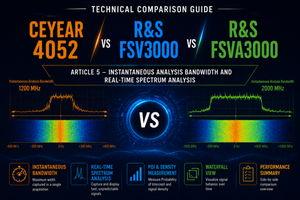
The Ceyear 4052 combines competitive RF performance with capabilities that become increasingly important in modern broadband applications, including 1.2 GHz instantaneous analysis bandwidth, high-speed I/Q acquisition and advanced real-time signal processing. While its absolute RF specifications are generally slightly below those of the FSVA3000, they remain fully competitive with the FSV3000 across most practical measurement scenarios and are complemented by features specifically designed for wideband communications, radar and electronic warfare applications.
Continue Reading
This article is part of the Technical Comparison Guide: Ceyear 4052 vs. R&S FSV3000 vs. R&S FSVA3000. Continue with the following chapters to explore each performance aspect in detail:
- Article 1 - EXECUTIVE SUMMARY
- Article 2 - FREQUENCY AND PHASE NOISE PERFORMANCE
- Article 3 - DANL, DYNAMIC RANGE AND LINEARITY
- Article 4 - AMPLITUDE ACCURACY, MEASUREMENT UNCERTAINTY AND RF PERFORMANCE SUMMARY (Current article)
- Article 5 - INSTANTANEOUS ANALYSIS BANDWIDTH AND REAL-TIME SPECTRUM ANALYSIS
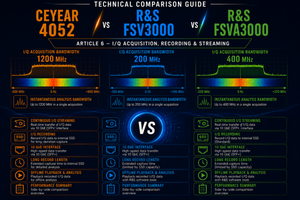
- Article 6 - I/Q ACQUISITION, RECORDING & STREAMING
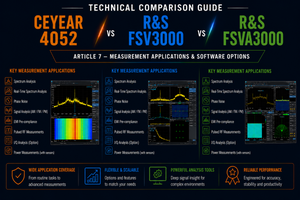
- Article 7 - MEASUREMENT APPLICATIONS & SOFTWARE OPTIONS
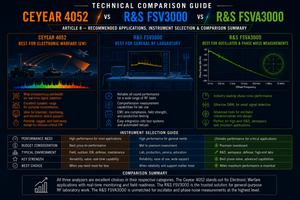
- Article 8 - RECOMMENDED APPLICATIONS & INSTRUMENT SELECTION AND COMPARISON SUMMARY