 Download the Complete Technical Comparison Guide
CHAPTER 3.3 I/Q ACQUISITION, RECORDING & STREAMING
Introduction
Complex I/Q data acquisition is a fundamental capability of modern signal and spectrum analyzers. Unlike conventional spectrum measurements, I/Q recording preserves both amplitude and phase information, enabling offline demodulation, radar signal analysis, SIGINT, electronic warfare (EW), algorithm development and post-processing of captured RF environments.
For broadband applications, not only the supported analysis bandwidth but also the recording architecture, storage capability and external data interfaces determine the practical usability of the instrument.
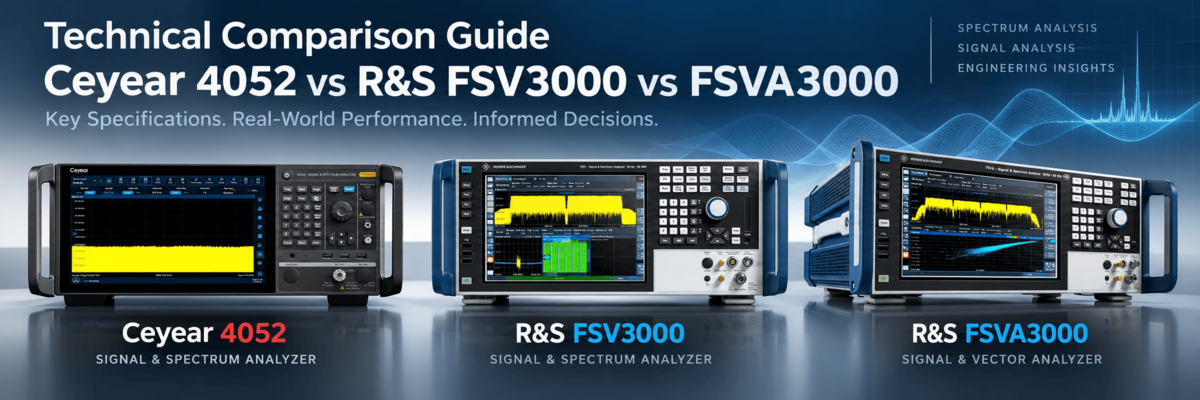
This section compares the published I/Q acquisition and recording capabilities of the Ceyear 4052 Series, R&S FSV3000 Series and R&S FSVA3000 Series using only officially specified characteristics.
3.3.1 I/Q Recording Architecture
Table 3-7. I/Q Recording and Playback
| Parameter | Ceyear 4052 | R&S FSV3000 | R&S FSVA3000 |
| I/Q Recording | Supported | Supported | Supported |
| I/Q Playback | Supported | Supported | Supported |
| Continuous Recording | Supported | Supported | Supported |
| Triggered Recording | Supported | Supported | Supported |
| Real-Time Preview During Recording | Supported | Not specified | Not specified |
Technical Observation
All three analyzer families support recording and playback of complex I/Q data. However, the Ceyear 4052 specification additionally describes real-time spectrum preview during recording, allowing users to monitor the RF environment while simultaneously acquiring broadband I/Q data.
3.3.2 Maximum Recording Bandwidth
Unlike many conventional spectrum analyzers, the Ceyear 4052 specifies the maximum recording bandwidth together with dedicated hardware interfaces and external data loggers.
Table 3-8. Maximum I/Q Recording Bandwidth
| Parameter | Ceyear 4052 | R&S FSV3000 | R&S FSVA3000 |
| Maximum Real-Time I/Q Recording Bandwidth | 1.2 GHz | Not specified | Not specified |
| Optical I/Q Output | Yes | Not specified | Not specified |
| Full-Bandwidth Recording | Yes | Not specified | Not specified |
Technical Observation
The Ceyear 4052 supports real-time recording of the full 1.2 GHz analysis bandwidth when equipped with the 4052-H12E wideband digital interface and the corresponding 4712E data recorder. The manufacturer also specifies 400 MHz real-time recording using the 4052-H12C interface and 4712C recorder.
The currently available FSV3000 and FSVA3000 specification documents confirm support for I/Q recording but do not publish an equivalent maximum sustained recording bandwidth.
3.3.3 I/Q Hardware Interfaces
Table 3-9. Dedicated I/Q Hardware Interfaces
| Interface | Ceyear 4052 | R&S FSV3000 | R&S FSVA3000 |
| 10 Gigabit Ethernet | ✔ | Supported | Supported |
| Optical I/Q Interface | 4052-H12C / H12E | Not specified | Not specified |
| Dedicated Data Recorder | 4712C / 4712E | Not specified | Not specified |
| Local SSD Expansion | Up to 4 TB (Option H19-4T) | ≥50 GB (nom.); ≥120 GB with B114 option | ≥120 GB (nom.); ≥50 GB with removable B20 option |
Technical Observation
The Ceyear 4052 provides a dedicated hardware ecosystem for broadband recording consisting of:
• 4052-H12C optical interface (up to 400 MHz I/Q output)
• 4052-H12E optical interface (up to 1.2 GHz I/Q output)
• 4712C external recorder
• 4712E external recorder
• Optional 4 TB internal SSD expansion.
These hardware options are explicitly documented by the manufacturer and are intended for continuous acquisition of large volumes of broadband RF data.
3.3.4 I/Q Memory Architecture
Table 3-10. Internal I/Q Memory
| Parameter | Ceyear 4052 | R&S FSV3000 | R&S FSVA3000 |
| ≤40 MHz Analysis Bandwidth | 500 M I/Q samples | Not specified | Not specified |
| >40 MHz Analysis Bandwidth | 1000 M I/Q samples | Not specified | Not specified |
| Sample Format (≤40 MHz) | 32-bit I / 32-bit Q | Not specified | Not specified |
| Sample Format (>40 MHz) | 16-bit I / 16-bit Q | Not specified | Not specified |
Technical Observation
The Ceyear 4052 specification provides detailed information regarding internal I/Q memory architecture, including recording depth and sample format. Equivalent information is not published in the currently available FSV3000 and FSVA3000 specification documents, preventing an objective numerical comparison.
3.3.5 Engineering Assessment
All three analyzer families support modern I/Q acquisition and recording workflows suitable for communication systems, modulation analysis and offline signal processing.
However, the Ceyear 4052 specification provides substantially more detailed information regarding its recording architecture. The published specifications include:
• full-bandwidth recording up to 1.2 GHz;
• dedicated optical I/Q interfaces (4052-H12C and 4052-H12E);
• dedicated external data recorders (4712C and 4712E);
• up to 4 TB internal SSD expansion;
• specified I/Q memory depth and sample formats.
The currently available Rohde & Schwarz FSV3000 and FSVA3000 specification documents confirm the availability of I/Q recording and analysis functions but do not publish equivalent quantitative specifications for recording bandwidth, memory depth or dedicated recording hardware. Consequently, a direct numerical comparison of recording performance cannot be established solely from the official datasheets.

Continue Reading
This article is part of the Technical Comparison Guide: Ceyear 4052 vs. R&S FSV3000 vs. R&S FSVA3000. Continue with the following chapters to explore each performance aspect in detail:
- Article 1 - EXECUTIVE SUMMARY
- Article 2 - FREQUENCY AND PHASE NOISE PERFORMANCE
- Article 3 - DANL, DYNAMIC RANGE AND LINEARITY
- Article 4 - AMPLITUDE ACCURACY, MEASUREMENT UNCERTAINTY AND RF PERFORMANCE SUMMARY
- Article 5 - INSTANTANEOUS ANALYSIS BANDWIDTH AND REAL-TIME SPECTRUM ANALYSIS
- Article 6 - I/Q ACQUISITION, RECORDING & STREAMING (Current article)
- Article 7 - MEASUREMENT APPLICATIONS & SOFTWARE OPTIONS
- Article 8 - RECOMMENDED APPLICATIONS & INSTRUMENT SELECTION AND COMPARISON SUMMARY
Technical Consultation
Need help selecting or configuring the right device? Our experts can advise you on devices, compatible accessories and technical requirements.
Contact us: tm@sea-ceyear.com