Cable & Antenna Analyzer Comparison: Ceyear 3681B vs R&S Cable Rider ZPH vs R&S ZVH
When selecting a handheld cable and antenna analyzer for field measurements, frequency range is only one part of the decision. The instrument must also provide the required RF performance, cable fault analysis functions, portability, connectivity, calibration capabilities, and options for extending its functionality.
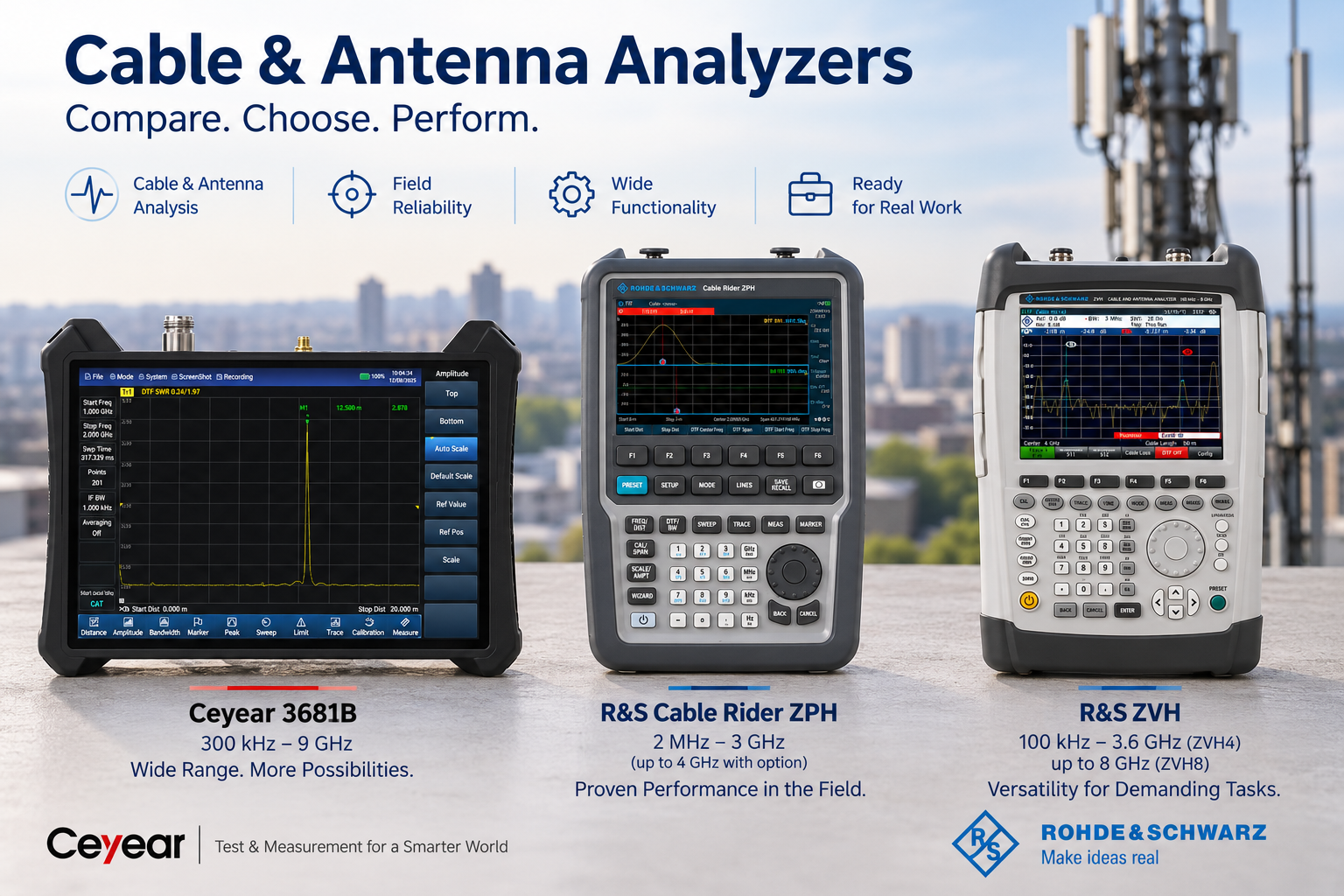
In this comparison, the Ceyear 3681B is evaluated against two well-known Rohde & Schwarz solutions: the R&S Cable Rider ZPH and the R&S ZVH. The comparison is based on the manufacturers' published technical specifications and focuses on parameters that are particularly important for cable, feeder and antenna testing.
The Ceyear 3681B is designed specifically as a compact cable and antenna analyzer covering 300 kHz to 9 GHz. It supports measurements including return loss, VSWR, impedance, cable loss and distance-to-fault (DTF), while an optional TDR function can additionally help identify the type of cable fault, such as an open or short circuit.
| Parameter | Ceyear 3681B | R&S Cable Rider ZPH | R&S ZVH |
| General | |||
| Manufacturer | Ceyear | Rohde & Schwarz | Rohde & Schwarz |
| Model variants | 3681B (handheld), 3681BU (USB module) | Model .02 (basic), Model .12 (combi with spectrum analyzer) | ZVH4, ZVH8 |
| Frequency range | 300 kHz to 9 GHz | 2 MHz to 3 GHz (up to 4 GHz with ZPH-B4 option) |
ZVH4: 100 kHz to 3.6 GHz ZVH8: 100 kHz to 8 GHz |
| Frequency accuracy | ±1.0 ppm | Aging ±1×10⁻⁶/yr, temp drift ±1 to ±3×10⁻⁶ | Aging ±1×10⁻⁶/yr, temp drift ±1×10⁻⁶ (optional GPS/precision reference for higher accuracy) |
| Display | 10.1" LCD capacitive touchscreen | Color display, WVGA 800×480 pixel | Color display, 640×480 pixel |
| Measurement Functions | |||
| Reflection (S11/S22) | Yes | Yes (S11) | Yes |
| Transmission (S21/S12) | No | Yes (model .12 only) | Yes (with ZVH-K39 option |
| 1-port cable loss | Yes | Yes | Yes |
| Distance-to-fault (DTF) | Yes | Yes | Yes |
| TDR (fault type analysis) | Yes (option 3681-S32) | No | No |
| Impedance measurement | Yes | No | Not listed (VNA option provides Smith chart) |
| Spectrum analyzer | No | Optional (ZPH-K1, model .12 only) | Optional (ZVH-K1) |
| Vector network analysis / vector voltmeter | No | No | Optional (ZVH-K42 / ZVH-K45) |
| Channel power meter | No | Optional (ZPH-K19) | Optional (ZVH-K19) |
| AM/FM analog modulation analysis | No | Optional (ZPH-K7, model .12 only) | No |
| EMF measurement | No | Optional (ZPH-K105, model .12 only) | Available via separate portable EMF system (TS-EMF) |
| Optical time-domain reflectometer (OTDR) / optical power meter | Optional (3681-S34, external USB OTDR) | No | No |
| USB/external power sensor support | Yes (options 3681-S01 CW power, 3681-S02 peak power) | Yes (ZPH-K9 option) | Yes (ZVH-K9 option) |
| Embedded electronic calibration | Optional (3681-S38) | External calibration unit (ZN-Z103) | External calibration unit / standards |
| RF Performance | |||
| Reflection tracking | ±0.08 dB (300 kHz–9 GHz) | n/a (uncertainty curve based, see uncertainty figure) | n/a (uncertainty curve based, see uncertainty figure) |
| Directivity (corrected) |
≥42 dB (300 kHz–6 GHz) ≥36 dB (6–9 GHz) |
>42 dB (nom., with ZN-Z103, 2 MHz–4 GHz) |
>43 dB (100 kHz–3 GHz) >37 dB (3–6 GHz) >31 dB (6–8 GHz) |
| Test port / source match (corrected) | ≥31 dB (300 kHz–9 GHz) | >36 dB (nom., 2 MHz–4 GHz) |
>40 dB (100 kHz–3 GHz) >37 dB (3–6 GHz) |
| IF bandwidth options | 3 Hz, 10 Hz, 30 Hz, 100 Hz, 300 Hz, 1 kHz, 3 kHz, 10 kHz, 30 kHz, 100 kHz | 10 kHz (S11), 10 Hz–1 MHz (S21) | 100 Hz to 100 kHz (1/3 sequence) |
| Maximum cable length (DTF) | Not explicitly stated | 1500 m (nom.) | 1500 m (nom.) |
| Physical & Environmental | |||
| Weight |
3681B: ≤1.3 kg (excl. battery) 3681BU: ≤0.4 kg |
2.5 kg | <3 kg |
| Dimensions (W×H×D) |
3681B: 258.3×179.4×37.0 mm 3681BU: 167×75×24.5 mm |
202×294×76 mm |
194×300×144 mm (with handle) 194×300×69 mm (without handle) |
| Operating temperature | -10°C to +55°C | -10°C to +55°C | -10°C to +55°C |
| Storage temperature | -40°C to +70°C | -20°C to +50°C | -20°C to +50°C |
| Battery life (typical) | 4 h |
Model .02: 9 h Model .12: 6.5 h (default) / 9 h (spectrum mode) |
4.5 h (nominal) |
| Connectivity & Interfaces | |||
| Test port connector | N-type, female | N-type, female | N-type, female |
| Communication interfaces |
3681B: USB Type-C ×1, Micro SD 3681BU: USB Type-C ×2 |
LAN 10/100BASE-T, USB 2.0 (mini-B and 2× Type-A) | LAN 10/100BASE-T, USB 1.1 (mini-B), USB Type-A |
| GPS/GNSS support | Optional (GPS/BeiDou, option 3681-H01) | Optional (ZPH-B10, model .02 only) | Optional (HA-Z240 GPS receiver) |
| Remote control command set | SCPI | SCPI 1997.0 | SCPI 1997.0 (ZVH-K40 option) |
| Ordering & Warranty | |||
| Base warranty | 1 year | 3 years (base unit), 1 year (other items) | 3 years (base unit), 1 year (other items) |
| Notable options | TDR, OTDR, USB power/peak power meter, Embedded electronic calibration, GPS/BeiDou, WiFi, memory card, docking station |
Frequency upgrade to 4 GHz, spectrum analyzer (model .12 only), GPS (model .02 only), AM/FM analysis (model .12 only), Power sensor support, Interference analysis (model .12 only), Signal strength mapping (model .12 only), Channel power meter, Advanced gated trigger measurements, EMF measurement |
Spectrum analysis, power meter, spectrogram, channel power meter, pulse measurement, transmission (S21/S12), VNA, vector voltmeter, remote control |
Sources: Ceyear 3681B/BU datasheet; R&S Cable Rider ZPH specifications (Version 10.00, September 2025); R&S ZVH specifications (Version 12.00, April 2026).
Frequency Range and RF Performance
One of the most significant differences between the three instruments is their frequency coverage.
The Ceyear 3681B covers 300 kHz to 9 GHz, providing a wider frequency range than the standard R&S Cable Rider ZPH, which covers 2 MHz to 3 GHz and can be extended to 4 GHz with the ZPH-B4 option. The R&S ZVH is available in two versions: the ZVH4 covers 100 kHz to 3.6 GHz, while the ZVH8 extends to 8 GHz.
The 3681B also provides a published reflection tracking specification of ±0.08 dB from 300 kHz to 9 GHz, together with valid directivity of ≥42 dB up to 6 GHz and ≥36 dB from 6 to 9 GHz, and valid source matching of ≥31 dB across the full frequency range.
This makes the 3681B particularly suitable for applications where a broad frequency range is required without moving to a higher-frequency instrument or adding a frequency-extension option.
Comprehensive Cable and Antenna Measurements
All three instruments support the fundamental measurements required for cable and antenna commissioning and maintenance, including reflection measurements, one-port cable loss and distance-to-fault analysis.
The Ceyear 3681B goes a step further by providing impedance measurement as part of its cable and feeder analysis functionality and by offering an optional TDR analysis function. The TDR capability is intended not only to locate a fault but also to help determine its nature.
The R&S ZPH focuses primarily on reflection, cable loss and DTF measurements, while transmission measurement is available on the Model .12 version. The R&S ZVH supports S11/S22 measurements and can add S21/S12 transmission measurements with the ZVH-K39 option.
For field engineers, this distinction can be important: the required functionality is available directly within the 3681B platform, while some advanced functions of the competing instruments depend on specific models or additional options.
Calibration is another important consideration for field measurements.
The Ceyear 3681B supports embedded calibration, allowing one-button calibration without the need for an external calibration kit when the corresponding option is installed. The manufacturer describes this feature as a way of improving measurement efficiency in field applications.
By comparison, the R&S Cable Rider ZPH uses an external calibration unit, such as the ZN-Z103, while the R&S ZVH specifications describe the use of external calibration standards/units.
For technicians working at multiple sites, reducing the amount of additional equipment required for calibration can be a practical advantage, particularly when measurements need to be performed quickly in confined or difficult-to-access locations.
Portability and Field Use
The physical design of the instrument can have a direct impact on productivity during installation and maintenance work.
The Ceyear 3681B weighs up to 1.3 kg excluding the battery, while the compact 3681BU USB version weighs up to 0.4 kg. The 3681B also features a 10.1-inch capacitive touchscreen designed for convenient operation in field environments.
The R&S Cable Rider ZPH weighs approximately 2.5 kg, while the R&S ZVH weighs less than 3 kg according to the comparison data. This makes the Ceyear solution notably lighter than both R&S handheld analyzers.
At the same time, the 3681B is specified for operation from −10 °C to +55 °C and storage from −40 °C to +70 °C, with a typical battery operating time of approximately 4 hours.
These characteristics are especially relevant for field installation, commissioning and maintenance of communication infrastructure, where equipment is frequently transported between sites.
Additional Measurement Capabilities
The Ceyear 3681B is not limited to conventional cable and antenna measurements.
Depending on the selected options and external accessories, the instrument can also perform CW and average power measurements using external USB power sensors, with supported sensors covering signals up to 67 GHz. Peak power measurement is also available with compatible USB peak power sensors.
Another notable feature is the optional optical time-domain reflectometer (OTDR) functionality. When connected to an external USB OTDR, the 3681B can be used to locate and analyze faults in optical fiber and measure optical power.
This combination allows the 3681B to serve as a broader field-testing platform rather than being limited exclusively to RF cable and antenna measurements.
Connectivity and System Integration
The Ceyear 3681B provides a USB Type-C interface and Micro SD card support, while the 3681BU provides two USB Type-C interfaces. Optional GPS/BeiDou and Wi-Fi functionality is also available according to the product configuration.
The 3681BU is particularly interesting for automated or multi-channel measurement systems. According to Ceyear, the USB module can be used to build multi-channel S11 measurement systems on production lines, providing a compact solution for test-system integration.
This gives the 3681 series two distinct use cases: the 3681B for portable field measurements and the 3681BU for integration into automated and multi-channel test systems.
Which Analyzer Is the Right Choice?
The three instruments address similar core applications, but their design priorities are different.
The R&S Cable Rider ZPH is a dedicated field cable and antenna analyzer with optional spectrum analysis and other measurement functions depending on the selected model and options. The R&S ZVH provides a broader measurement platform, including optional spectrum analysis, transmission measurements, VNA/vector-voltmeter functions and power measurement capabilities.
The Ceyear 3681B, meanwhile, combines a wide 300 kHz–9 GHz frequency range, strong published reflection specifications, DTF and cable analysis, optional TDR, embedded calibration, USB power measurement, optional OTDR functionality and a lightweight 10.1-inch touchscreen platform.
For users whose primary requirements are cable, feeder and antenna installation, commissioning, troubleshooting and maintenance, the 3681B offers a combination of frequency coverage, RF performance, portability and expandable functionality that makes it a strong alternative to established R&S solutions.
Conclusion
The comparison demonstrates that choosing a cable and antenna analyzer should not be based solely on brand or frequency range. Important factors include the actual measurement functions available in the base instrument, the need for additional options and accessories, RF performance, calibration requirements, portability and the ability to expand the instrument for future applications.
With coverage from 300 kHz to 9 GHz, a 10.1-inch touchscreen, a weight of up to 1.3 kg excluding the battery, integrated cable and antenna analysis functions, optional TDR and OTDR capabilities, USB power measurement and embedded calibration, the Ceyear 3681B provides a versatile platform for both field and system-level applications.
For organizations looking for a modern alternative to the R&S Cable Rider ZPH or R&S ZVH, the Ceyear 3681B deserves consideration not only as a cost-effective solution, but also on the basis of its technical specifications, functionality and field-oriented design.
Technical Sources
- Ceyear 3681B/3681BU Datasheet
- Rohde & Schwarz Cable Rider ZPH Specifications, Version 10.00
- Rohde & Schwarz ZVH Specifications, Version 12.00
Where to Buy
🔵 The Ceyear 3681B Cable & Antenna Analyzer is now available to order from SEA Components GmbH, the official Ceyear partner in the European Union. For sales inquiries and quotations, please contact us at tm@sea-ceyear.com