 Download the Complete Technical Comparison Guide
CHAPTER 4. MEASUREMENT APPLICATIONS & SOFTWARE OPTIONS
4.1 Introduction
Modern signal and spectrum analyzers are modular measurement platforms whose functionality is largely determined by installed software applications and hardware options. While the RF performance defines the instrument's measurement capability, the available application software determines which communication standards, modulation formats and specialized analyses can be performed.
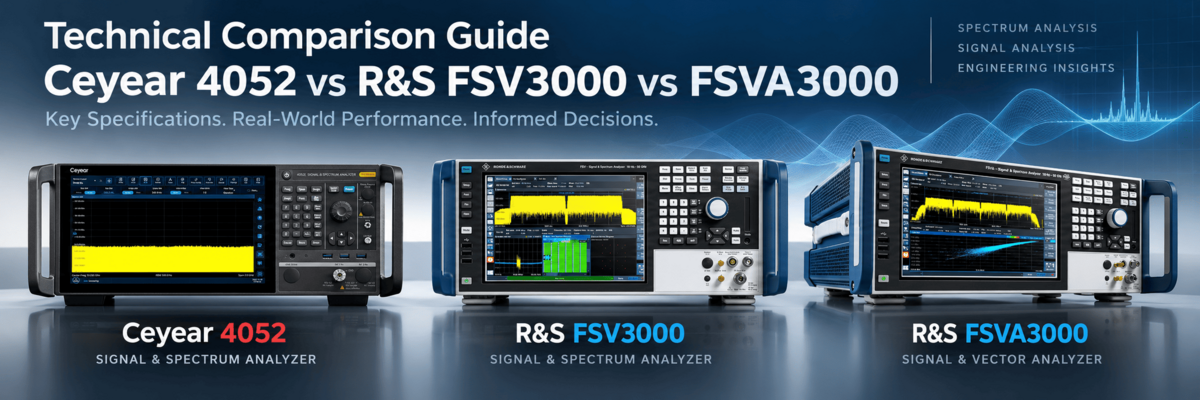
The Ceyear 4052, R&S FSV3000 and R&S FSVA3000 all support a wide range of optional measurement applications. However, the available software packages, supported standards and licensing models differ significantly.
This chapter compares the measurement applications officially supported by each analyzer family based exclusively on the published manufacturer specifications.
4.2 General Measurement Capability
Table 4-1. Standard Measurement Functions
| Measurement Function | Ceyear 4052 | R&S FSV3000 | R&S FSVA3000 |
| Spectrum Analysis | ✔ | ✔ | ✔ |
| Channel Power | ✔ | ✔ | ✔ |
| Occupied Bandwidth (OBW) | ✔ | ✔ | ✔ |
| Adjacent Channel Power (ACP/ACLR) | ✔ | ✔ | ✔ |
| Harmonic Measurements | ✔ | ✔ | ✔ |
| Spurious Emissions | ✔ | ✔ | ✔ |
| Third-Order Intercept (TOI) | ✔ | ✔ | ✔ |
| Noise Marker | ✔ | ✔ | ✔ |
| Carrier-to-Noise Ratio (C/N) | ✔ | ✔ | ✔ |
| Emission Mask | ✔ | ✔ | ✔ |
| Limit Lines | ✔ | ✔ | ✔ |
| Marker Functions | ✔ | ✔ | ✔ |
Technical Observation
All three analyzer families provide a comprehensive set of standard spectrum analysis functions required for laboratory measurements, production testing and RF component characterization. No significant functional differences are identified in the published standard measurement capabilities.
4.3 Analog Modulation Analysis
Table 4-2. Analog Demodulation
| Measurement | Ceyear 4052 | R&S FSV3000 | R&S FSVA3000 |
| AM | ✔ | ✔ | ✔ |
| FM | ✔ | ✔ | ✔ |
| PM | ✔ | ✔ | ✔ |
| Audio Spectrum | ✔ | ✔ | ✔ |
| SINAD | ✔ | ✔ | ✔ |
| THD | ✔ | ✔ | ✔ |
Technical Observation
Each analyzer supports analog modulation analysis for AM, FM and PM signals. These capabilities are suitable for broadcast transmitters, land-mobile radio systems, avionics and general RF communication equipment.
4.4 Digital Modulation Analysis
Table 4-3. Digital Modulation Applications
| Application | Ceyear 4052 | R&S FSV3000 | R&S FSVA3000 |
| ASK | ✔ | ✔ | ✔ |
| FSK | ✔ | ✔ | ✔ |
| PSK | ✔ | ✔ | ✔ |
| QPSK | ✔ | ✔ | ✔ |
| QAM | ✔ | ✔ | ✔ |
| APSK | ✔ | ✔ | ✔ |
| OFDM | ✔ | ✔ | ✔ |
| EVM Measurement | ✔ | ✔ | ✔ |
| Constellation Display | ✔ | ✔ | ✔ |
| Eye Diagram | ✔ | ✔ | ✔ |
Technical Observation
All three platforms provide comprehensive digital modulation analysis suitable for modern communication systems. Supported measurements include constellation analysis, EVM, symbol quality and modulation accuracy.
4.5 Cellular Communication Standards
Table 4-4. Cellular Measurement Applications
| Standart | Ceyear 4052 | R&S FSV3000 | R&S FSVA3000 |
| GSM / EDGE | Optional | Optional | Optional |
| WCDMA / HSPA | Optional | Optional | Optional |
| LTE FDD | Optional | Optional | Optional |
| LTE TDD | Optional | Optional | Optional |
| NB-IoT | Optional | Optional | Optional |
| LTE-M | Optional | Optional | Optional |
| 5G NR FR1 | Optional | Optional | Optional |
| 5G NR FR2 | Optional | Optional | Optional |
Technical Observation
Support for cellular standards depends on the installed application software and licensed options. Users should verify the required measurement application before ordering the instrument.
4.6 Wireless Connectivity Standards
Table 4-5. WLAN & Short-Range Communications
| Standart | Ceyear 4052 | R&S FSV3000 | R&S FSVA3000 |
| Bluetooth | Optional | Optional | Optional |
| Bluetooth LE | Optional | Optional | Optional |
| IEEE 802.11a/b/g | Optional | Optional | Optional |
| IEEE 802.11n | Optional | Optional | Optional |
| IEEE 802.11ac | Optional | Optional | Optional |
| Wi-Fi 6 (802.11ax) | Optional | Optional | Optional |
| Wi-Fi 7 (802.11be) | Optional | Optional | Optional |
Technical Observation
Support for WLAN standards is implemented through dedicated vector signal analysis software and depends on both software licensing and the available analysis bandwidth.
4.7 Radar & Pulse Analysis
Table 4-6. Radar Measurement Applications
| Measurement | Ceyear 4052 | R&S FSV3000 | R&S FSVA3000 |
| Pulse Width | ✔ | ✔ | ✔ |
| PRI Measurement | ✔ | ✔ | ✔ |
| Pulse Spectrum | ✔ | ✔ | ✔ |
| Chirp Analysis | Optional | Optional | Optional |
| Pulse Compression | Optional | Optional | Optional |
| Frequency Agile Radar | ✔ | ✔ | ✔ |
Technical Observation
All three analyzers support pulse measurements. The available analysis depth depends on the installed pulse-analysis software and the real-time acquisition bandwidth.
4.8 EMC & Spectrum Monitoring
Table 4-7. EMC Applications
| Measurement | Ceyear 4052 | R&S FSV3000 | R&S FSVA3000 |
| EMI Pre-compliance | Optional | Optional | Optional |
| CISPR Detectors | Optional | Optional | Optional |
| Spectrum Monitoring | ✔ | ✔ | ✔ |
| Interference Hunting | ✔ | ✔ | ✔ |
| Direction Finding Support | Optional | Optional | Optional |
Technical Observation
All three analyzer families can be configured for EMC pre-compliance measurements and spectrum monitoring applications through dedicated software packages.
4.9 Engineering Assessment
The comparison demonstrates that all three analyzer families provide a broad portfolio of software-based RF measurement applications covering conventional spectrum analysis, analog and digital modulation, cellular communications, wireless connectivity, radar and spectrum monitoring.
The principal difference between the platforms is not the availability of common RF measurements but the implementation of optional application software, licensing structure and hardware dependencies.
Before selecting an analyzer for a specific project, users should verify:
• the required measurement application;
• the corresponding software option number;
• the necessary hardware options (analysis bandwidth, frequency range, real-time capability);
• any prerequisite licenses.
For advanced applications such as 5G NR, Wi-Fi 7, radar analysis and wideband vector signal analysis, the software configuration is often as important as the RF hardware itself. Consequently, the complete instrument configuration should always be defined according to the intended measurement task rather than based solely on the base instrument specifications.

Continue Reading
This article is part of the Technical Comparison Guide: Ceyear 4052 vs. R&S FSV3000 vs. R&S FSVA3000. Continue with the following chapters to explore each performance aspect in detail:
- Article 1 - EXECUTIVE SUMMARY
- Article 2 - FREQUENCY AND PHASE NOISE PERFORMANCE
- Article 3 - DANL, DYNAMIC RANGE AND LINEARITY
- Article 4 - AMPLITUDE ACCURACY, MEASUREMENT UNCERTAINTY AND RF PERFORMANCE SUMMARY
- Article 5 - INSTANTANEOUS ANALYSIS BANDWIDTH AND REAL-TIME SPECTRUM ANALYSIS
- Article 6 - I/Q ACQUISITION, RECORDING & STREAMING
- Article 7 - MEASUREMENT APPLICATIONS & SOFTWARE OPTIONS (Current article)
- Article 8 - RECOMMENDED APPLICATIONS & INSTRUMENT SELECTION AND COMPARISON SUMMARY