 Download the Complete Technical Comparison Guide
CHAPTER 3. REAL-TIME & WIDEBAND SIGNAL ANALYSIS
3.1 Introduction
Modern RF and microwave systems increasingly employ broadband modulation schemes, frequency-agile signals and short-duration transient events that cannot be fully characterized using conventional swept spectrum analysis.
Applications such as 5G NR FR2, Wi-Fi 7, ultra-wideband (UWB), radar, satellite communications, electronic warfare (EW), SIGINT and spectrum monitoring require analyzers capable of capturing hundreds of megahertz or even gigahertz of instantaneous spectrum while maintaining high dynamic range, uninterrupted signal acquisition and high-speed digital processing.
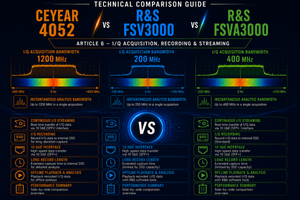
Although the Ceyear 4052 Series, R&S FSV3000 Series and R&S FSVA3000 Series all support wideband signal analysis, their digital IF architectures differ significantly. This chapter compares their instantaneous analysis bandwidth, real-time processing capability, I/Q acquisition performance and interface architecture based exclusively on the official manufacturer specifications.
3.2 INSTANTANEOUS ANALYSIS BANDWIDTH
Instantaneous Analysis Bandwidth (IABW) defines the maximum spectrum that can be digitized and processed without sweeping the local oscillator. Unlike traditional swept analysis, wide instantaneous bandwidth enables simultaneous observation of multiple signals, short transient events and broadband modulation.
Table 3-1. Instantaneous Analysis Bandwidth Options
| Analysis Bandwidth | Ceyear 4052 | R&S FSV3000 | R&S FSVA3000 |
| Standard | 10 MHz | 10 MHz | 10 MHz |
| Option 1 | H38-40 → 40 MHz | B40 → 40 MHz | B40 → 40 MHz |
| Option 2 | H38-200 → 200 MHz | B200 → 200 MHz | B200 → 200 MHz |
| Option 3 | H38-400 → 400 MHz | — | B400 → 400 MHz |
| Option 4 | H38-600 → 600 MHz | — | B601 → 600 MHz |
| Option 5 | H38-1200 → 1.2 GHz | — | B1001 → 1 GHz |
Technical Observation
All three analyzer families begin with a standard 10 MHz analysis bandwidth and can be upgraded through optional digital IF hardware.
The R&S FSV3000 supports analysis bandwidths up to 200 MHz, covering the requirements of LTE, Wi-Fi 6E and most conventional communication systems.
The R&S FSVA3000 extends the available bandwidth to 1 GHz via option B1001, making it suitable for broadband communication and advanced RF research.
The Ceyear 4052 provides the broadest upgrade path, including 200 MHz, 400 MHz, 600 MHz, and 1.2 GHz (Option H38-1200). These intermediate configurations allow users to optimize system cost while selecting only the bandwidth required for a particular application.
3.3 Application Suitability
Table 3-2. Typical Application Requirements
| Application | Typical Required Bandwidth | Ceyear 4052 | R&S FSV3000 | R&S FSVA3000 |
| GSM / WCDMA | <20 MHz | ✔ | ✔ | ✔ |
| LTE | 20 MHz | ✔ | ✔ | ✔ |
| 5G NR FR1 | 100 MHz | ✔ | ✔ | ✔ |
| Wi-Fi 6E | 160 MHz | ✔ | ✔ | ✔ |
| 5G NR FR2 | 400 MHz | ✔ | ✖ | ✔ |
| Wi-Fi 7 | 320 MHz | ✔ | ✖ | ✔ |
| Ultra-Wideband (UWB) | 500 MHz | ✔ | ✖ | ✔ |
| Broadband Radar | 500 MHz–1 GHz | ✔ | ✖ | ✔ |
| Electronic Warfare (EW) | >1 GHz preferred | ✔ | ✖ | ○ |
| Spectrum Monitoring | Wide bandwidth advantageous | ✔ | ✔ | ✔ |
Technical Observation
For traditional communication systems, an analysis bandwidth of 160 MHz is generally sufficient. However, emerging applications such as Wi-Fi 7, wideband radar and electronic warfare increasingly require several hundred megahertz or more of instantaneous bandwidth.
In these applications, the broader digital IF architecture of the Ceyear 4052 and FSVA3000 significantly reduces measurement time and eliminates the need for multiple frequency sweeps.
3.5 Engineering Assessment
The comparison demonstrates three distinct architectural approaches.
The R&S FSV3000 is optimized for conventional RF measurements and production environments, where analysis bandwidths up to 200 MHz satisfy the majority of communication standards.
The R&S FSVA3000 combines high-end RF performance with 1 GHz instantaneous analysis bandwidth, making it well suited for advanced communication research, radar development and laboratory characterization.
The Ceyear 4052 offers the broadest bandwidth scalability, ranging from 10 MHz to 1.2 GHz through clearly defined hardware options. The availability of intermediate bandwidth upgrades (200 MHz, 400 MHz and 600 MHz) provides greater configuration flexibility than the compared instruments and allows users to select the most cost-effective solution for specific applications. Its 1.2 GHz instantaneous analysis bandwidth is particularly advantageous for broadband radar, electronic warfare, SIGINT and next-generation wireless communication systems.
3.2 REAL-TIME SPECTRUM ANALYSIS
Introduction
Real-Time Spectrum Analysis (RTSA) enables continuous observation of the RF spectrum without acquisition gaps, allowing engineers to detect burst transmissions, frequency-hopping signals, intermittent interference and other transient events that may not be captured by conventional swept spectrum analysis.
Compared with traditional swept measurements, RTSA continuously digitizes and processes the incoming RF signal over a fixed instantaneous bandwidth, providing simultaneous time-domain and frequency-domain analysis together with advanced triggering and persistence functions.
The Ceyear 4052, R&S FSV3000 and R&S FSVA3000 all provide real-time spectrum analysis capabilities. However, the published specifications differ considerably in the amount of quantitative information provided. Consequently, only parameters explicitly specified by the manufacturers are compared in this chapter.
Table 3-4. Real-Time Spectrum Analysis Overview
| Parameter | Ceyear 4052 | R&S FSV3000 | R&S FSVA3000 |
| Real-Time Spectrum Analysis | Supported | Supported | Supported |
| Real-Time Spectrum Display | Yes | Yes | Yes |
| Waterfall Display | Yes | Yes | Yes |
| Spectrogram | Yes | Yes | Yes |
| Persistence Display | Yes | Yes | Yes |
| Density Display | Yes | Yes | Yes |
| Frequency Mask Trigger | Supported | Supported | Supported |
| Time Trigger | Supported | Supported | Supported |
| Power Trigger | Supported | Supported | Supported |
Technical Observation
All three analyzer families provide modern FPGA-based real-time spectrum analysis with continuous visualization of the RF spectrum and support common triggering mechanisms for transient signal analysis.
Although the overall functionality is similar, the manufacturers publish significantly different levels of quantitative performance data. Therefore, direct numerical comparison is only possible where identical specification parameters are available.
3.2.1 Published Real-Time Performance Specifications
Unlike the Rohde & Schwarz datasheets, the Ceyear 4052 specification includes quantitative real-time processing characteristics. These published values provide additional insight into the analyzer's transient signal processing capability.
| Parameter | Ceyear 4052 | R&S FSV3000 | R&S FSVA3000 |
| Maximum Real-Time Analysis Bandwidth | 400 MHz | Not specified | 200 MHz (with K200R option) |
| 100% Frequency-Domain Intercept Duration | < 0.6 µs | Not specified | Not specified |
| Time-Domain Intercept Duration | < 2 ns | Not specified | Not specified |
| Spectrum Processing Speed | 1,500,000 spectra/s | Not specified | Not specified |
Technical Observation
According to the published specification, the Ceyear 4052 provides a real-time analysis bandwidth of up to 400 MHz, a 100% frequency-domain intercept duration below 0.6 µs, a time-domain intercept duration below 2 ns, and a maximum spectrum processing rate of 1.5 million spectra per second. These specifications characterize the analyzer's capability to detect short-duration transient signals during continuous real-time operation.
The currently available R&S FSV3000 and FSVA3000 specification documents confirm support for real-time spectrum analysis. The FSVA3000 additionally publishes a maximum real-time analysis bandwidth of 200 MHz with the optional R&S®FSV3-K200R application (limited by the installed analysis bandwidth option); the FSV3000 has no equivalent option. Neither R&S datasheet publishes intercept duration or spectrum update rate figures comparable to the Ceyear specification. Consequently, a direct numerical comparison is only possible for real-time bandwidth, and cannot be made for the other parameters on the basis of the official datasheets.
3.2.2 Real-Time Signal Visualization
All three analyzer families provide multiple visualization modes for observing transient RF behaviour.
Table 3-6. Real-Time Visualization Functions
| Fuction | Ceyear 4052 | R&S FSV3000 | R&S FSVA3000 |
| Spectrum Display | ✔ | ✔ | ✔ |
| Waterfall | ✔ | ✔ | ✔ |
| Spectrogram | ✔ | ✔ | ✔ |
| Persistence | ✔ | ✔ | ✔ |
| Density Display | ✔ | ✔ | ✔ |
| Marker Functions | ✔ | ✔ | ✔ |
| Time-Domain Display | ✔ | ✔ | ✔ |
Technical Observation
These visualization tools allow engineers to analyse transient RF behaviour simultaneously in both the frequency and time domains. Waterfall and persistence displays are particularly useful for identifying burst transmissions, intermittent interference and frequency-hopping signals that may be difficult to observe using conventional swept measurements.
3.2.3 Engineering Assessment
All three instruments provide comprehensive real-time spectrum analysis capabilities suitable for modern RF measurements, including burst signal detection, interference analysis and spectrum monitoring.
The primary difference lies not in the availability of RTSA functionality but in the level of published performance specifications.
The Ceyear 4052 datasheet provides quantitative real-time performance metrics, including 400 MHz real-time analysis bandwidth, sub-microsecond frequency-domain intercept capability and 1.5 million spectra per second processing speed, offering a clear indication of transient signal analysis performance.
The currently available Rohde & Schwarz FSV3000 and FSVA3000 specification documents confirm the availability of real-time spectrum analysis and associated visualization tools but do not publish equivalent quantitative transient-processing parameters. Therefore, no objective numerical comparison of real-time processing performance can be established using the official specifications alone.

Continue Reading
This article is part of the Technical Comparison Guide: Ceyear 4052 vs. R&S FSV3000 vs. R&S FSVA3000. Continue with the following chapters to explore each performance aspect in detail:
- Article 1 - EXECUTIVE SUMMARY
- Article 2 - FREQUENCY AND PHASE NOISE PERFORMANCE
- Article 3 - DANL, DYNAMIC RANGE AND LINEARITY
- Article 4 - AMPLITUDE ACCURACY, MEASUREMENT UNCERTAINTY AND RF PERFORMANCE SUMMARY
- Article 5 - INSTANTANEOUS ANALYSIS BANDWIDTH AND REAL-TIME SPECTRUM ANALYSIS (Current article)
- Article 6 - I/Q ACQUISITION, RECORDING & STREAMING
- Article 7 - MEASUREMENT APPLICATIONS & SOFTWARE OPTIONS
- Article 8 - RECOMMENDED APPLICATIONS & INSTRUMENT SELECTION AND COMPARISON SUMMARY
Technical Consultation
Need help selecting or configuring the right device? Our experts can advise you on devices, compatible accessories and technical requirements.
Contact us: tm@sea-ceyear.com